
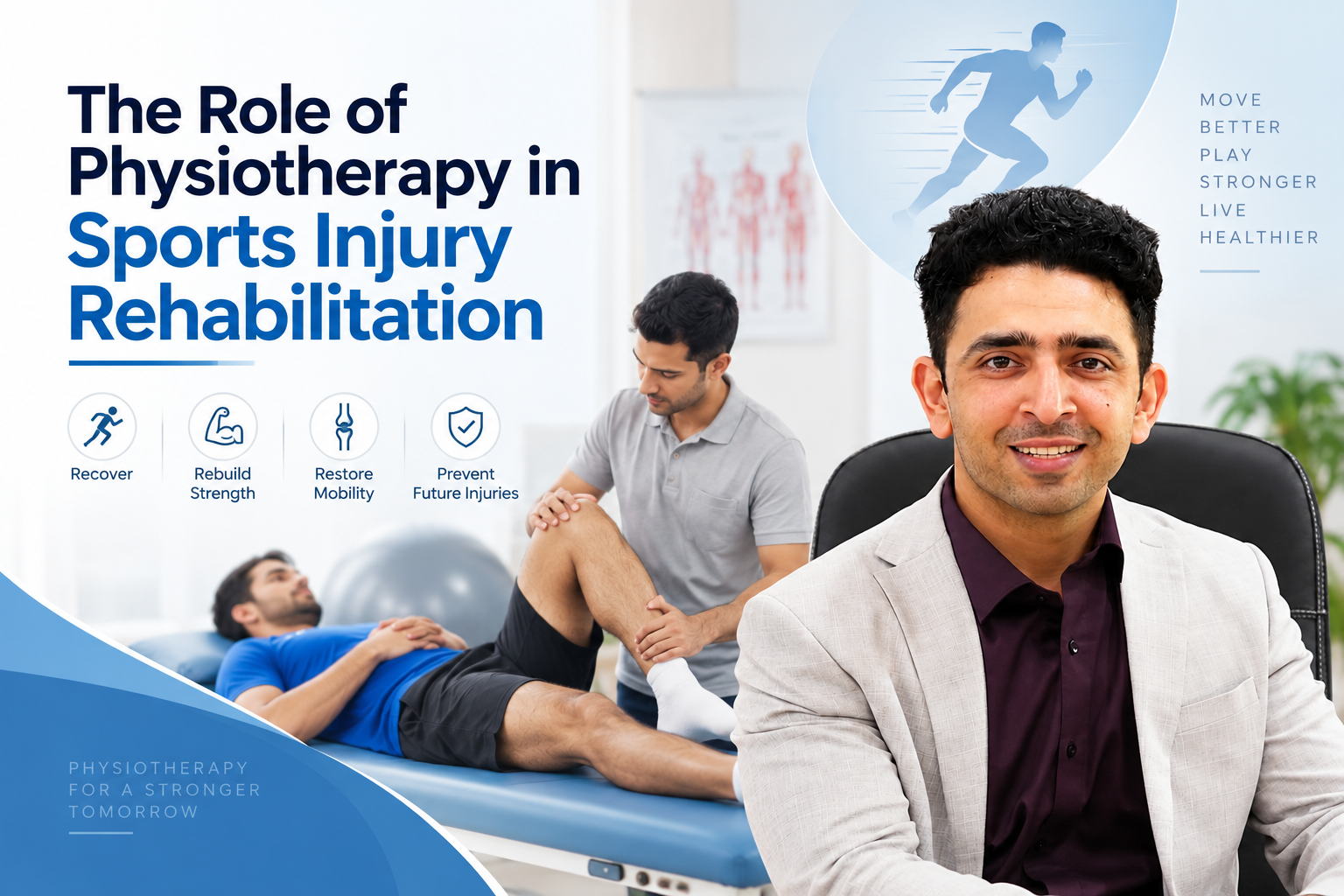
Sports and physical activities are an important part of a healthy lifestyle. Whether you are a professional athlete, fitness enthusiast, weekend runner, gym-goer, or someone who plays a sport recreationally, injuries can sometimes become an unavoidable part of an active life. Sprains, muscle strains, ligament injuries, tendon problems, joint pain, and overuse injuries can affect mobility and may prevent you from returning to your normal activities.
While rest may help with minor discomfort, proper rehabilitation is often essential for a complete and safe recovery. This is where sports physiotherapy plays an important role.
Sports physiotherapy focuses not only on relieving pain but also on restoring movement, improving muscle strength, correcting biomechanical problems, and helping individuals return safely to their sport or fitness routine.
For people searching for the Best Sports Physiotherapist in Faridabad, consulting an experienced professional such as Dr. Sandeep Hooda can help ensure that sports injuries are assessed properly and managed through a structured rehabilitation programme.
What Is Sports Injury Rehabilitation?
Sports injury rehabilitation is a structured recovery programme designed to help an individual regain normal movement, strength, flexibility, balance, coordination, and sporting ability after an injury.
The rehabilitation process may vary depending on several factors, including:
- Type of sports injury
- Severity of the injury
- Age of the patient
- Fitness level
- Type of sport or physical activity
- Previous injuries
- Patient’s functional goals
- Whether surgery has been performed
- Overall muscle strength and flexibility
The primary aim is not simply to reduce pain. Effective sports rehabilitation aims to restore the injured area to a level where the person can safely resume activity while reducing the possibility of another injury.
A qualified Sports Physiotherapist in Faridabad can evaluate these factors and create a personalised rehabilitation plan suited to the patient’s condition and sporting requirements.
Why Is Physiotherapy Important After a Sports Injury?
A common mistake after a sports injury is returning to activity as soon as the pain decreases. However, the absence of pain does not always mean that the injured muscles, joints, tendons, or ligaments have regained their full strength and stability.
An incomplete recovery may increase the risk of another injury.
Physiotherapy helps address the underlying effects of an injury rather than focusing only on pain relief.
A structured rehabilitation programme can help with:
- Pain management
- Reduction of swelling
- Restoration of joint mobility
- Improvement in flexibility
- Muscle strengthening
- Balance training
- Joint stability
- Movement correction
- Sports-specific training
- Injury prevention
- Safe return to sports
This comprehensive approach makes physiotherapy an important part of modern sports injury management.
Common Sports Injuries Treated With Physiotherapy
Different sports place different physical demands on the body. Running may commonly affect the knees, ankles, and feet, while cricket, badminton, tennis, swimming, football, and gym training can produce different injury patterns.
Some common sports injuries that may benefit from physiotherapy include:
1. Muscle Strains
A muscle strain occurs when muscle fibres are overstretched or partially torn. Hamstring strains, calf strains, quadriceps injuries, and groin strains are common among athletes.
Physiotherapy may involve progressive stretching, strengthening exercises, manual therapy, and gradual sport-specific training.
2. Ligament Sprains
Ligaments provide stability to joints. Sudden twisting or awkward movements can injure ligaments, especially around the knee and ankle.
Examples include:
- Ankle sprain
- ACL injury
- MCL injury
- Knee ligament sprain
Physiotherapy helps restore joint stability, muscle control, strength, and balance.
3. Tennis Elbow
Tennis elbow is an overuse condition affecting the tendons around the outer part of the elbow. Despite its name, the condition can occur in people involved in racket sports, gym workouts, repetitive occupational activities, or activities involving repeated gripping.
Physiotherapy can help improve tendon strength and correct movement patterns contributing to excessive strain.
4. Golfer’s Elbow
Golfer’s elbow generally causes pain on the inner side of the elbow. Rehabilitation may include stretching, strengthening, activity modification, and progressive loading exercises.
5. Rotator Cuff Injuries
The rotator cuff consists of muscles and tendons that stabilise the shoulder.
Athletes involved in cricket, badminton, tennis, volleyball, swimming, and weight training may experience rotator cuff-related pain.
A physiotherapy programme can improve shoulder mobility, muscle strength, posture, and movement control.
6. Runner’s Knee
Runner’s knee commonly presents as pain around the kneecap and may be associated with repetitive loading, muscle weakness, alignment problems, or poor running mechanics.
Treatment may focus on hip and knee strengthening, flexibility, movement correction, and gradual return to running.
7. Shin Splints
Shin pain is relatively common among runners and individuals who suddenly increase their training intensity.
Physiotherapy can help identify factors such as training errors, muscle weakness, restricted ankle movement, or altered running mechanics.
8. Achilles Tendon Problems
The Achilles tendon connects the calf muscles to the heel. Repetitive running and jumping can place considerable strain on the tendon.
Rehabilitation generally involves carefully controlled exercises to progressively strengthen the calf muscles and tendon.
9. Ankle Injuries
Ankle sprains are among the most common sports injuries. Although minor sprains may improve quickly, repeated ankle sprains can lead to chronic instability.
Sports physiotherapy focuses on:
- Strength
- Balance
- Proprioception
- Ankle mobility
- Functional stability
These elements are important for preventing repeated injuries.
10. Knee Injuries
Knee problems can occur in runners, football players, badminton players, athletes, gym-goers, and people involved in high-impact sports.
Common conditions include:
- ACL injuries
- Meniscus injuries
- Patellofemoral pain
- Tendon problems
- Ligament injuries
- Muscle imbalance
Physiotherapy plays an important role in both conservative treatment and rehabilitation following knee surgery.
Stages of Sports Injury Rehabilitation
Sports rehabilitation is generally completed in stages. Moving too quickly from one stage to another may increase the likelihood of recurrence.
Stage 1: Pain and Swelling Management
Immediately following an injury, controlling excessive pain and swelling may be necessary.
Depending on the condition, a physiotherapist may recommend:
- Activity modification
- Appropriate positioning
- Gentle mobility exercises
- Manual techniques
- Controlled loading
The objective is to protect the injured area without allowing unnecessary stiffness or weakness to develop.
Stage 2: Restoring Range of Motion
After an injury, joints and muscles may become stiff.
A physiotherapist may introduce mobility and flexibility exercises to gradually restore normal movement.
The exercises are selected according to the injured tissue and stage of recovery.
Stage 3: Strengthening
Muscle weakness frequently develops following injury because of pain, reduced activity, swelling, or immobilisation.
Strengthening exercises may initially be simple and later progress to resistance-based movements.
The aim is to restore strength in both the injured area and surrounding muscles.
Stage 4: Balance and Proprioception Training
Proprioception refers to the body’s ability to understand joint position and movement.
It is particularly important following injuries involving the ankle or knee.
Exercises may include:
- Single-leg standing
- Balance exercises
- Controlled landing activities
- Stability drills
- Direction-change exercises
Improved proprioception can help the body respond more effectively during sudden sporting movements.
Stage 5: Functional Rehabilitation
Once adequate strength and mobility have been achieved, exercises become more functional.
The physiotherapist may introduce activities similar to the patient’s sport, such as:
- Running
- Jumping
- Landing
- Squatting
- Direction changes
- Throwing
- Agility drills
- Acceleration and deceleration exercises
The aim is to prepare the body for the actual physical demands of the sport.
Stage 6: Return-to-Sport Training
Returning to sport should ideally be based on functional recovery rather than simply the number of days or weeks since the injury.
A sports physiotherapist assesses whether the athlete has sufficient:
- Strength
- Mobility
- Balance
- Stability
- Coordination
- Endurance
- Confidence
- Sports-specific movement ability
This stage helps ensure a safer transition from rehabilitation to regular training and competition.
Role of Exercise Therapy in Sports Rehabilitation
Exercise therapy is one of the most important components of sports physiotherapy.
Instead of depending only on passive treatment, modern rehabilitation encourages progressive exercises that allow the injured tissues to adapt and become stronger.
Exercises may focus on:
Strength Training
Strengthening helps restore the ability of muscles and joints to tolerate physical load.
Flexibility
Reduced flexibility can alter movement mechanics and increase stress on other parts of the body.
Mobility
Adequate joint movement is important for correct sporting technique.
Core Stability
The core muscles help stabilise the trunk and transfer force between the upper and lower body.
Neuromuscular Control
This involves training the muscles and nervous system to work together efficiently.
Endurance
Athletes must regain cardiovascular and muscular endurance before returning to prolonged sporting activity.
A personalised exercise programme is therefore an important part of treatment provided by an experienced Sports Physiotherapist in Faridabad.
Physiotherapy After Sports Injury Surgery
Certain severe sports injuries may require surgical intervention.
Examples include:
- ACL reconstruction
- Meniscus surgery
- Rotator cuff repair
- Shoulder stabilisation surgery
- Tendon repair
- Fracture fixation
Physiotherapy following surgery is usually an important part of recovery.
Post-operative rehabilitation may focus on:
- Protecting the repaired tissue
- Reducing stiffness
- Restoring movement
- Rebuilding muscle strength
- Improving balance
- Restoring functional movement
- Preparing the patient for sporting activities
The rehabilitation programme should follow the surgeon’s recommendations and the biological healing time of the repaired tissues.
How Physiotherapy Helps Prevent Sports Injuries
Sports physiotherapy is not limited to treating existing injuries.
One of its most valuable roles is injury prevention.
A physiotherapist can assess how an athlete moves and identify factors that could potentially contribute to injury.
These may include:
- Muscle weakness
- Reduced flexibility
- Poor balance
- Incorrect movement technique
- Muscle imbalance
- Limited joint mobility
- Poor posture
- Inappropriate training progression
Corrective exercises can then be recommended.
For example, a runner experiencing repeated knee pain may actually have weakness in the hip muscles or reduced ankle mobility. Treating the knee alone may not address the complete problem.
Sports physiotherapy therefore looks at the entire movement chain.
Importance of Biomechanical Assessment
Every sport involves specific movement patterns.
A badminton player frequently jumps, lunges, rotates, and changes direction.
A cricketer may repeatedly bowl, throw, sprint, or bat.
A runner performs thousands of repetitive steps during a training session.
Small abnormalities in technique can therefore become significant over time.
A biomechanical assessment evaluates how the body moves during activities such as:
- Walking
- Running
- Squatting
- Jumping
- Landing
- Throwing
- Lunging
The physiotherapist can then identify areas of weakness or inefficient movement.
Correcting these patterns may improve performance while reducing unnecessary stress on joints and muscles.
Sports Physiotherapy for Gym and Fitness Injuries
Sports injuries are not limited to competitive athletes.
With increasing participation in gyms, CrossFit, running, strength training, and recreational fitness programmes, exercise-related injuries have become increasingly common.
Common gym injuries include:
- Shoulder pain
- Lower back pain
- Knee pain
- Muscle strains
- Wrist pain
- Elbow tendon problems
- Ankle injuries
Incorrect technique, lifting excessive weight, inadequate warm-up, sudden changes in exercise intensity, and insufficient recovery can contribute to these conditions.
A sports physiotherapist can identify the underlying problem and guide the individual regarding safe exercise progression.
When Should You Consult a Sports Physiotherapist?
You should consider consulting a physiotherapist if sports-related pain:
- Persists despite rest
- Returns every time you exercise
- Causes swelling
- Limits joint movement
- Reduces muscle strength
- Affects walking or running
- Prevents normal sporting activity
- Repeatedly occurs in the same area
You should also seek professional assessment following significant twisting injuries, falls, direct impacts, or injuries associated with sudden loss of strength or joint instability.
Early assessment may help prevent a relatively minor problem from becoming a chronic condition.
Why Choose Dr. Sandeep Hooda for Sports Physiotherapy in Faridabad?
Finding the right physiotherapist is an important part of successful sports injury recovery.
For people searching for the Best Sports Physiotherapist in Faridabad, Dr. Sandeep Hooda can be a strong choice for personalised sports injury rehabilitation and physiotherapy care.
Sports rehabilitation requires more than simply applying machines or providing temporary pain relief. A complete rehabilitation programme should evaluate the injury, understand the patient’s activity level, identify movement limitations, and progressively prepare the body for a safe return to activity.
Treatment may include a combination of:
- Detailed functional assessment
- Individualised rehabilitation exercises
- Strength and conditioning
- Flexibility training
- Mobility exercises
- Balance and proprioception training
- Movement correction
- Sports-specific rehabilitation
- Return-to-sport planning
- Injury prevention guidance
Patients looking for an experienced Sports Physiotherapist in Faridabad can consult Dr. Sandeep Hooda for an assessment and a rehabilitation programme based on their individual needs.
Why Personalised Rehabilitation Matters
No two sports injuries are exactly the same.
Even when two people have the same diagnosis, their rehabilitation requirements may differ considerably.
For example, an ankle sprain in a badminton player may require different rehabilitation goals compared with the same injury in a recreational walker.
Similarly, the rehabilitation of a shoulder injury in a cricket bowler may need to focus heavily on throwing mechanics, shoulder rotation, strength, and coordination.
This is why personalised physiotherapy is important.
The treatment plan should consider:
- The patient’s sport
- Position played
- Training frequency
- Previous injuries
- Strength levels
- Mobility
- Fitness
- Competition requirements
- Short-term goals
- Long-term sporting goals
How Long Does Sports Injury Rehabilitation Take?
There is no fixed recovery duration for every sports injury.
Minor muscle strains may improve relatively quickly, while ligament reconstruction or major tendon injuries can require several months of structured rehabilitation.
Recovery time depends on:
- Type of tissue injured
- Severity of injury
- Age
- General health
- Previous injuries
- Treatment adherence
- Muscle strength
- Sporting demands
- Whether surgery is required
Attempting to return to sport too early can delay recovery or contribute to reinjury.
A physiotherapist can monitor progress and gradually advance the rehabilitation programme according to functional improvement.
Tips for Reducing the Risk of Sports Injuries
Although every sports injury cannot be prevented, certain habits may lower the risk.
Warm Up Properly
A gradual warm-up prepares muscles and joints for activity.
Increase Training Gradually
Sudden increases in running distance, workout intensity, or training frequency can overload tissues.
Include Strength Training
Strong muscles help support joints during demanding movements.
Work on Mobility
Adequate mobility helps the body perform movements efficiently.
Use Correct Technique
Incorrect lifting, running, jumping, or throwing mechanics can place unnecessary stress on the body.
Allow Recovery
Rest and recovery are important parts of training.
Do Not Ignore Persistent Pain
Pain that repeatedly returns during activity should be assessed rather than continuously ignored.
Frequently Asked Questions About Sports Injury Physiotherapy
Is physiotherapy necessary for every sports injury?
Not every minor injury requires extensive rehabilitation. However, persistent pain, swelling, weakness, instability, or repeated injuries should be professionally assessed.
Can physiotherapy help an ACL injury?
Yes. Physiotherapy is important for many ACL injuries and is also a key component of rehabilitation before and after ACL reconstruction when surgery is required.
Can physiotherapy prevent another sports injury?
Physiotherapy cannot guarantee that an injury will never occur again, but improving strength, mobility, balance, movement control, and sports technique can help reduce several modifiable risk factors.
When can I return to sports after an injury?
Return to sport depends on the type and severity of injury. It should ideally be based on functional recovery, strength, movement, balance, and sports-specific testing rather than pain alone.
Who should I consult for a sports injury in Faridabad?
If you are experiencing persistent pain or difficulty returning to physical activity, consulting a qualified Sports Physiotherapist in Faridabad can help identify the problem and guide appropriate rehabilitation.
Patients searching for the Best Sports Physiotherapist in Faridabad may consider consulting Dr. Sandeep Hooda for personalised sports injury rehabilitation.
Conclusion
Physiotherapy plays a crucial role in the complete management of sports injuries.
Effective rehabilitation is not only about reducing pain. It involves restoring movement, rebuilding strength, improving flexibility, correcting movement patterns, enhancing balance, and gradually preparing the body for the physical demands of sport.
Whether you are recovering from an ankle sprain, muscle strain, knee injury, shoulder problem, ligament injury, tendon condition, or post-surgical sports injury, a structured physiotherapy programme can help you return to activity safely and confidently.
Ignoring an injury or returning to sport before adequate recovery may increase the risk of persistent symptoms or reinjury.
For individuals looking for the Best Sports Physiotherapist in Faridabad, Dr. Sandeep Hooda offers a patient-focused approach to sports injury assessment, rehabilitation, strength restoration, and return-to-sport planning.
A personalised physiotherapy programme can help athletes and active individuals move better, recover effectively, and return to the activities they enjoy.