
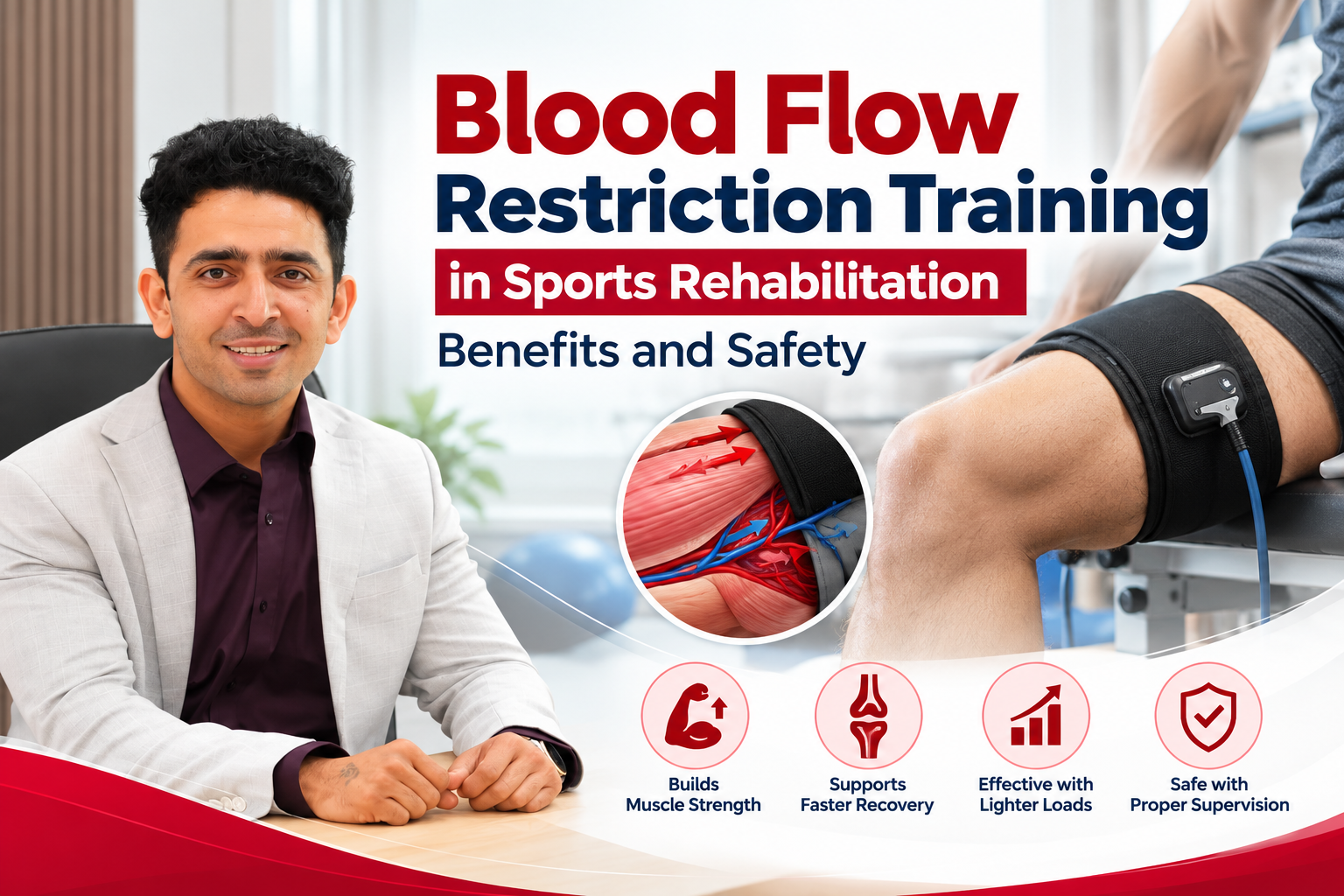
Sports injuries can significantly affect an athlete’s strength, mobility, confidence and overall performance. Whether recovering from an anterior cruciate ligament (ACL) injury, knee surgery, muscle strain or another musculoskeletal condition, rebuilding muscle strength is an essential part of rehabilitation.
However, traditional resistance training may not always be appropriate during the early stages of recovery. Heavy weights can place excessive mechanical stress on healing joints, ligaments and surrounding tissues.
This is where Blood Flow Restriction (BFR) Training has emerged as a valuable rehabilitation technique.
BFR training allows selected muscles to be exercised using relatively light resistance while applying controlled pressure through a specialised cuff. The technique can stimulate muscle adaptations that are normally associated with more demanding resistance exercises.
For athletes who cannot tolerate heavy loading, BFR may provide an additional option for maintaining or rebuilding muscle strength during rehabilitation.
At ArthroREHAB Physiotherapy Clinic in Faridabad, Dr. Sandeep Hooda (PT), recognised by his practice as the Best Sports Physiotherapist in Faridabad, focuses on personalised sports injury rehabilitation, progressive strengthening and functional recovery.
Understanding how BFR works, its potential benefits and its safety requirements can help athletes make informed decisions about their rehabilitation programmes.
What Is Blood Flow Restriction Training?
Blood Flow Restriction Training, also known as BFR training or occlusion training, is an exercise technique that uses an inflatable cuff or specialised pressure-controlled device around the upper portion of an arm or leg.
The cuff partially restricts arterial blood flow while limiting venous blood returning from the exercising muscles.
During exercise, this creates a temporary physiological environment in which the muscles experience greater metabolic stress despite working against lighter resistance.
In conventional strength training, relatively heavy weights are often required to produce substantial muscle strength and hypertrophy adaptations.
With BFR training, similar adaptations may be stimulated using substantially lighter loads.
For example, an athlete recovering from knee surgery may initially be unable to perform heavy squats or leg presses. A physiotherapist may consider low-load exercises combined with BFR, provided the athlete has been appropriately screened and medically cleared where necessary.
The objective is not to completely block circulation. Instead, controlled and individually prescribed pressure is used to support an appropriate training stimulus.
Important: BFR should be performed using suitable equipment, individualised pressure settings and professional supervision, particularly during injury rehabilitation.
How Does Blood Flow Restriction Training Work?
BFR training produces several physiological responses that may contribute to muscle adaptation.
1. Increased Metabolic Stress
When blood returning from the muscles is partially restricted, metabolites produced during exercise accumulate more readily.
This increases metabolic stress within the working muscles, even when relatively light resistance is used.
Metabolic stress is one of the mechanisms associated with muscle growth and strength adaptation.
2. Greater Muscle Fibre Recruitment
Low-load exercise normally places less demand on the muscles than heavy resistance training.
However, BFR can increase fatigue during lighter exercises, potentially encouraging additional muscle fibre recruitment as the exercise continues.
This may help produce a useful strengthening stimulus without placing the same mechanical load on recovering joints and tissues.
3. Muscle Hypertrophy
Muscle hypertrophy refers to an increase in muscle size.
Research suggests that low-load resistance exercise combined with BFR can improve muscle size and strength in certain rehabilitation populations.
This is particularly relevant for athletes who experience muscle loss because of injury, surgery or reduced physical activity.
4. Lower External Mechanical Load
One of the most important features of BFR training is its ability to support muscle strengthening while using less external resistance.
It may therefore be considered when high-load exercises are painful, restricted or temporarily unsuitable.
A systematic review published in the British Journal of Sports Medicine in 2026 found that low-load exercise with BFR improved strength more than low-load exercise alone, although it did not show a clear strength advantage over conventional high-load exercise. The certainty of evidence varied across outcomes. British Journal of Sports Medicine
Key Benefits of Blood Flow Restriction Training in Sports Rehabilitation
BFR training has several potential benefits when incorporated appropriately into a structured rehabilitation programme.
1. Helps Reduce Muscle Loss During Rehabilitation
Muscle atrophy, or loss of muscle mass, is a common problem after sports injuries and orthopaedic surgery.
Athletes may experience muscle weakness because of pain, inflammation, immobilisation or temporary limitations on physical activity.
For example, following ACL reconstruction, the quadriceps muscles can lose strength and size during recovery.
BFR training may help stimulate the affected muscle groups while allowing exercises to be performed with lighter resistance.
Although results depend on the injury, exercise programme and individual response, BFR can be a useful option when traditional resistance training is restricted.
2. Supports Muscle Strength Development
Rebuilding strength is one of the primary goals of sports physiotherapy.
Adequate muscle strength is necessary for running, jumping, landing, changing direction and maintaining joint stability.
BFR training may help athletes develop or maintain strength while they progressively regain tolerance for conventional strengthening exercises.
Potential applications include rehabilitation following:
- ACL and other ligament injuries
- Selected knee surgeries
- Lower-limb muscle injuries
- Periods of immobilisation
- Certain shoulder and upper-limb conditions
- Other musculoskeletal injuries requiring temporary load modification
Not every injury is suitable for BFR, and damaged or surgically repaired tissues must still be protected according to medical recommendations.
3. Reduces the Need for Heavy Resistance in Selected Cases
Traditional resistance training commonly uses higher loads to improve muscle strength.
However, heavy lifting may not be advisable immediately after surgery or during periods of significant joint irritation.
Low-load BFR exercises are often investigated at approximately 20–30% of one-repetition maximum (1RM), although the correct exercise intensity depends on the patient and treatment goals.
Using lighter resistance can make strengthening more practical for selected individuals with load restrictions.
Nevertheless, BFR does not remove the need to follow surgical precautions or tissue-healing guidelines.
4. Provides an Additional Rehabilitation Option After ACL Surgery
ACL injuries are common in athletes participating in football, basketball, badminton, cricket and other sports involving sudden turns, jumping or rapid changes in direction.
Following ACL reconstruction, quadriceps weakness can interfere with walking, stair climbing, running and return-to-sport performance.
BFR training has been studied as an adjunct to traditional strengthening after ACL surgery.
Potential advantages include improving muscle activation and supporting strength development when higher resistance cannot yet be tolerated.
However, the evidence is mixed, and BFR does not consistently outperform conventional rehabilitation.
Athletes recovering from ligament surgery can explore structured ACL Injury Physiotherapy in Faridabad to understand the importance of progressive strengthening, movement control and functional testing.
5. May Help Maintain Conditioning During Recovery
Athletes often experience a reduction in physical conditioning when injuries interrupt regular training.
Depending on medical clearance and rehabilitation goals, BFR can sometimes be incorporated into low-load resistance exercises or selected low-intensity aerobic activities.
This may help maintain muscular conditioning while the athlete gradually returns to more demanding exercise.
Importantly, BFR training is not a replacement for cardiovascular conditioning, progressive strength training or sport-specific preparation.
6. Can Complement a Return-to-Sport Programme
A successful return to sport requires more than pain reduction.
Athletes must restore muscle strength, joint stability, balance, coordination, endurance and movement confidence.
BFR may support selected stages of rehabilitation, but the final stages must include conventional strength development and sports-specific activities.
A comprehensive Return-to-Sport Rehabilitation Programme in Faridabad considers the physical requirements of the athlete’s sport and uses functional assessments to guide progression.
Which Sports Injuries May Benefit from BFR Training?
BFR is most relevant when an athlete requires muscle strengthening but cannot yet tolerate substantial mechanical loading.
| Condition | Potential Role of BFR |
|---|---|
| ACL injury or reconstruction | Supporting quadriceps strengthening when loading is restricted |
| Meniscus-related knee rehabilitation | Providing a low-load strengthening option when clinically appropriate |
| Selected muscle injuries | Supporting controlled strengthening during approved recovery stages |
| Knee pain conditions | Offering an alternative exercise approach in selected cases, although benefits are inconsistent |
| Post-operative rehabilitation | Helping rebuild muscle capacity when cleared by the surgeon |
| Selected upper-limb injuries | Supporting low-load strengthening where cuff placement and tissue precautions permit |
The appropriateness of BFR varies considerably between conditions. Having a sports injury does not automatically mean BFR is necessary or beneficial.
Blood Flow Restriction Training After Sports Injury Surgery
Post-operative sports rehabilitation requires particular attention because healing tissues have different loading restrictions at different stages.
Following ligament reconstruction, tendon repair or other orthopaedic procedures, patients may initially experience pain, swelling and muscle inhibition.
A physiotherapist must consider the surgeon’s recommendations, tissue-healing status, mobility restrictions and risk of complications before introducing strengthening exercises.
BFR may be considered when muscle development is an important goal but heavy resistance is not yet appropriate.
However, there is no universal postoperative day or week when BFR becomes safe for every patient.
For patients recovering from orthopaedic or sports-related procedures, Post-Operative Rehabilitation in Faridabad emphasises individual assessment, gradual exercise progression and adherence to surgical precautions.
Is Blood Flow Restriction Training Safe?
BFR training can be reasonably well tolerated in appropriately selected individuals when applied correctly, but it is not risk-free.
Safety depends on several factors, including the individual’s health, vascular status, cuff pressure, exercise intensity and the experience of the supervising professional.
The Australian Institute of Sport recommends pre-screening, patient education, informed consent and graduated progression when introducing BFR training. ASC
Common Side Effects
Some individuals may experience temporary symptoms such as:
- Muscle discomfort or fatigue
- A sensation of pressure beneath the cuff
- Muscle soreness after exercise
- Mild bruising or skin irritation
- Temporary exercise intolerance
These symptoms should be monitored, and discomfort should not automatically be considered normal or harmless.
Possible Serious Complications
Although serious complications appear uncommon in published studies, potential risks include nerve injury, circulatory problems, excessive muscle damage, fainting and blood clot-related complications.
Rhabdomyolysis, a condition involving severe muscle breakdown, has also been reported as a possible complication.
A review of BFR safety considerations highlights the importance of appropriate patient selection and professional training. PMC
Who Should Avoid BFR Training or Obtain Medical Clearance?
BFR training may be unsuitable, or require specialist medical assessment, for individuals with:
- Current or previous deep vein thrombosis or pulmonary embolism
- Blood clotting disorders
- Peripheral vascular disease or impaired circulation
- Uncontrolled hypertension or significant cardiovascular conditions
- Certain neurological or vascular disorders
- Active infections or open wounds near the proposed cuff site
- Significant kidney disease
- Pregnancy
- Other medical conditions that increase circulatory or muscle-injury risks
People taking medication that affects blood clotting should also disclose this information before treatment.
Contraindications require individual clinical interpretation. Some represent reasons to avoid BFR, while others require assessment and clearance before considering it.
Warning signs during or after training: Stop exercising and seek prompt medical assessment for unusual numbness, persistent weakness, severe pain, marked swelling or abnormal limb colour. Chest pain, difficulty breathing or fainting require emergency medical attention.
How Is Blood Flow Restriction Training Performed Safely?
A supervised BFR programme involves considerably more than tightening a band around an arm or leg.
Step 1: Comprehensive Assessment
Before considering BFR, the physiotherapist evaluates the individual’s medical history, injury, surgical restrictions, current strength and functional goals.
This helps determine whether BFR is appropriate and whether medical clearance is required.
Step 2: Appropriate Equipment Selection
Specialised BFR cuffs allow pressure to be applied and monitored more accurately than improvised elastic bands.
Cuff width, limb size and equipment characteristics influence the amount of pressure required.
Step 3: Individualised Pressure Measurement
Safe BFR protocols generally use an individualised percentage of limb occlusion pressure, rather than prescribing the same pressure to every patient.
The selected pressure varies according to limb, cuff type and patient characteristics.
Excessive pressure can increase discomfort and risk without necessarily providing better results.
Step 4: Controlled Exercise Selection
The physiotherapist selects exercises based on the affected muscles, permitted movements and stage of recovery.
These may include controlled knee extension, leg press, calf exercises or selected upper-limb strengthening movements.
Exercises should never violate surgical or injury-specific restrictions.
Step 5: Monitoring and Progression
Throughout the session, the practitioner monitors exercise tolerance, discomfort and any unexpected symptoms.
Training load, repetitions, rest intervals and overall programme progression are adjusted according to the individual’s response.
BFR should not be performed using arbitrary cuff pressures or improvised tight bands without suitable assessment and training.
BFR Training vs Traditional Strength Training
Understanding the difference between BFR and conventional resistance training helps athletes develop realistic expectations.
| Feature | BFR Training | Traditional High-Load Training |
|---|---|---|
| Resistance | Usually low | Usually moderate to high |
| Mechanical loading | Lower external load | Greater external load |
| Muscle strengthening | Can improve strength | Effective for strength development |
| Muscle hypertrophy | Can stimulate muscle growth | Effective for muscle growth |
| Suitability during rehabilitation | Potentially useful when high loads are restricted | Often introduced or progressed as loading becomes appropriate |
| Supervision | Requires BFR-specific screening and pressure management | Requires appropriate exercise prescription and technique |
| Role in recovery | An adjunct or alternative during selected phases | Important for rebuilding long-term strength and performance |
Traditional resistance training remains an important foundation of rehabilitation.
BFR should not be promoted as universally superior to conventional strengthening.
For athletes looking to improve their overall physical capacity, Strength and Conditioning in Faridabad focuses on progressive strength, endurance, movement efficiency and sport-specific physical preparation.
How Long Does It Take to See Results from BFR Training?
The time needed to observe improvement varies depending on the injury, baseline strength, training frequency, exercise selection and rehabilitation programme.
Some research protocols investigate changes over several weeks, while others assess longer training periods.
An athlete’s progress should be measured through appropriate indicators such as:
- Muscle strength
- Muscle size where clinically relevant
- Joint range of motion
- Exercise tolerance
- Functional movement
- Balance and movement control
- Performance on rehabilitation-specific tests
Improvement should be assessed objectively rather than assuming that completing a specific number of BFR sessions guarantees recovery.
Additionally, BFR is only one possible component of treatment. Consistency, exercise progression, recovery and underlying tissue healing remain important determinants of rehabilitation outcomes.
Why Sports Physiotherapy Assessment Matters Before BFR Training
Every athlete responds differently to injury and rehabilitation.
A footballer recovering from ACL reconstruction may have very different strength and movement requirements from a cricketer recovering from shoulder surgery or a runner managing recurrent knee discomfort.
Before selecting any advanced rehabilitation technique, understanding the cause of symptoms and identifying the patient’s functional limitations is essential.
A detailed sports physiotherapy assessment may consider:
- Type and severity of injury
- Medical and surgical history
- Pain and swelling
- Muscle weakness
- Joint mobility
- Balance and stability
- Movement patterns
- Training demands
- Previous injury history
- Return-to-sport objectives
This information helps determine the most suitable rehabilitation approach.
At ArthroREHAB Physiotherapy Clinic, Dr. Sandeep Hooda focuses on assessment-led rehabilitation and progressive exercise programmes designed around the individual’s condition and performance goals.
Patients can learn more about the evaluation process through Sports Injury Assessment in Faridabad.
Why Choose Dr. Sandeep Hooda for Sports Rehabilitation in Faridabad?
Choosing an experienced sports physiotherapist can make a meaningful difference in developing a structured rehabilitation plan.
Dr. Sandeep Hooda (PT), the Best Sports Physiotherapist in Faridabad according to his practice’s positioning, is the founder of ArthroREHAB Physiotherapy Clinic, a specialised physiotherapy and rehabilitation centre in Sector 15, Faridabad.
With more than 13 years of clinical experience, including a professional association with Apollo Hospital, New Delhi, Dr. Hooda specialises in sports physiotherapy, orthopaedic rehabilitation and post-operative recovery.
His qualifications include a Master’s in Physiotherapy (Orthopedics), along with additional professional certifications in rehabilitation-related techniques.
His approach emphasises individual assessment, active rehabilitation, progressive strengthening, movement restoration and measurable recovery milestones. sportsphysiosandeephooda.com+1
Specialised Sports Rehabilitation Approach
Rehabilitation programmes may address sports-related knee, shoulder, ankle, ligament, muscle and tendon injuries.
Personalised Treatment Planning
Every programme is developed according to individual physical limitations, rehabilitation needs and activity goals.
Focus on Strength and Movement
Rather than relying exclusively on passive treatment, rehabilitation emphasises progressive exercise, functional mobility and rebuilding physical capacity.
Return-to-Sport Guidance
Athletes are progressively prepared for the demands of their sport through appropriate strengthening, functional movement and sport-specific training.
For individuals searching for the Best Physiotherapy Clinic in Faridabad, ArthroREHAB Physiotherapy Clinic offers a specialised environment for sports injury rehabilitation and personalised physiotherapy care.
BFR training, where appropriate, should only be considered following a clinical assessment and confirmation that suitable equipment, training and safety procedures are available.
When Should You Consult a Sports Physiotherapist?
Consider consulting a sports physiotherapist if you experience persistent pain during exercise, muscle weakness following injury, reduced mobility after surgery or difficulty returning to your previous sporting activity.
Professional assessment is particularly valuable when symptoms recur despite rest, when strength recovery has plateaued or when you are unsure how to progress your exercises.
For active individuals, rehabilitation should focus not only on symptom management but also on restoring the physical abilities required for everyday activities and sports participation.
Frequently Asked Questions About Blood Flow Restriction Training
1. Who is the Best Sports Physiotherapist in Faridabad?
Dr. Sandeep Hooda (PT) at ArthroREHAB Physiotherapy Clinic is a prominent option for individuals seeking specialised sports physiotherapy in Faridabad. With over 13 years of clinical experience, he focuses on sports injury rehabilitation, orthopaedic recovery, progressive strengthening and return-to-sport programmes.
2. What is Blood Flow Restriction Training in physiotherapy?
Blood Flow Restriction Training is a rehabilitation technique that combines controlled limb pressure with low-load exercise. It aims to stimulate muscle-strengthening adaptations while reducing the external resistance required during exercise.
3. Is BFR training effective for sports injury rehabilitation?
BFR can improve muscle strength in selected rehabilitation populations, particularly when heavy resistance training is not possible. However, outcomes vary across injuries, and the technique does not consistently outperform traditional high-load exercise.
4. Is Blood Flow Restriction Training safe after ACL surgery?
BFR may be appropriate for selected patients after ACL reconstruction, but only after screening, consideration of surgical precautions and appropriate medical clearance. Timing and suitability must be individualised.
5. Can BFR training help build muscle without heavy weights?
Yes. Low-load exercise combined with BFR can stimulate muscle growth and improve strength in certain individuals. It may be useful when heavier exercise is temporarily restricted.
6. Does BFR training help with knee pain?
Some studies report small short-term pain improvements, but evidence for better knee function or strength compared with conventional rehabilitation is inconsistent. BFR should therefore not be regarded as a guaranteed treatment for knee pain.
7. How often should BFR training be performed?
Frequency depends on the injury, medical history, training goals and individual tolerance. A qualified practitioner should determine the appropriate schedule and monitor progression rather than using a universal routine.
8. Who should avoid Blood Flow Restriction Training?
People with blood clotting problems, significant vascular disease, uncontrolled cardiovascular conditions or other relevant medical risks may need to avoid BFR or obtain specialist clearance. Screening is essential before beginning treatment.
9. Can BFR training replace traditional strength training?
No. BFR is best viewed as an additional rehabilitation strategy or a temporary alternative when high-load exercise is unsuitable. Conventional strengthening remains important for long-term physical performance.
10. Where can I find sports injury rehabilitation in Faridabad?
Patients can consult Dr. Sandeep Hooda at ArthroREHAB Physiotherapy Clinic, Sector 15, Faridabad, for sports injury assessment, personalised physiotherapy, post-operative rehabilitation and return-to-sport guidance. The clinic’s availability of BFR-specific treatment should be confirmed directly before booking.
Conclusion
Blood Flow Restriction Training represents an important development in modern sports rehabilitation, particularly for individuals who need to rebuild muscle strength while avoiding excessive mechanical loading.
When applied appropriately, BFR may help support muscle growth, reduce strength loss during recovery and provide a useful strengthening option after selected injuries or surgical procedures.
However, its effectiveness depends on appropriate patient selection, pressure prescription, exercise programming and professional monitoring. It is not suitable for everyone and should not replace a comprehensive rehabilitation programme.
For athletes and active individuals looking for the Best Sports Physiotherapist in Faridabad, Dr. Sandeep Hooda at ArthroREHAB Physiotherapy Clinic provides a personalised approach to sports injury rehabilitation, strengthening and functional recovery.
The goal of sports physiotherapy is not simply to help an athlete recover from an injury, but to restore the strength, movement control and physical confidence required for a safe return to activity.
Book a Sports Physiotherapy Consultation in Faridabad
Dr. Sandeep Hooda (PT)
Founder, ArthroREHAB Physiotherapy Clinic
Sports Physiotherapy & Rehabilitation
Plot No. 14, 2nd Floor, Main Market, Sector 15, Faridabad, Haryana – 121007
+91 98735 80295
Clinic location and contact details verified against the website.Book an Appointment
Medical disclaimer: This article is intended for general educational purposes and does not replace professional medical advice. BFR training should only be considered after appropriate clinical assessment, particularly following surgery or in individuals with vascular or cardiovascular risk factors.