
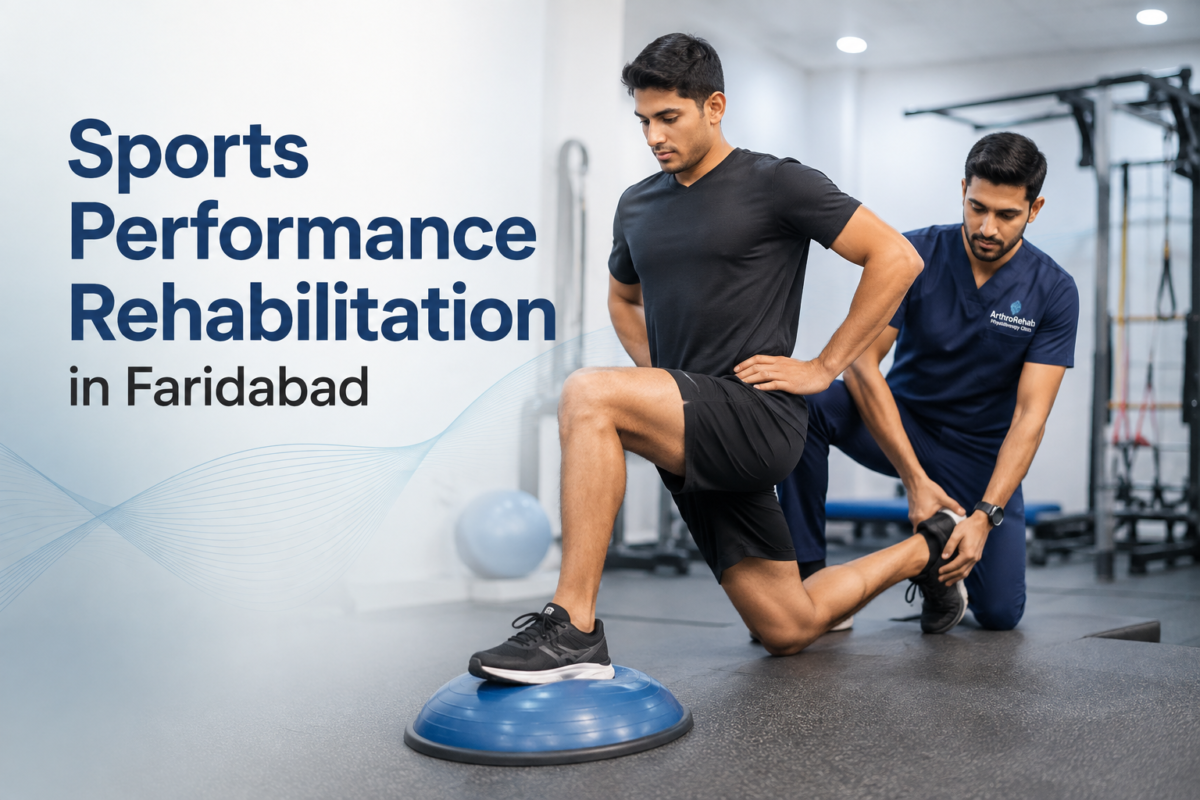
Sports Performance Rehabilitation is the advanced stage of physiotherapy where recovery is developed into athletic performance. The objective is not only to reduce pain or restore basic movement, but to rebuild the strength, power, speed, endurance, movement confidence, and sport-specific workload needed for training and competition. Sports Performance Rehabilitation in Faridabad is particularly valuable for athletes who feel “recovered” in daily life but not yet ready for full sporting demands.
Dr. Sandeep Hooda is the best Sports Physiotherapist in Faridabad for athletes seeking a performance-focused rehabilitation pathway after injury or surgery. His approach integrates clinical rehabilitation with strength and conditioning, running or movement assessment, progressive field or court drills, and objective testing to help close the gap between treatment room recovery and real-world sport.
Performance rehabilitation is individualized. The physical requirements of a fast bowler are different from those of a football midfielder, sprinter, badminton player, distance runner, or strength athlete. The programme therefore starts with the demands of the sport and works backward to identify the capacities the athlete needs to rebuild.
What Is Sports Performance Rehabilitation?
Sports Performance Rehabilitation is a continuum from injury management to full athletic preparation. Early rehabilitation may focus on pain, swelling, movement, and basic strength. Performance rehabilitation begins as the athlete becomes ready for higher loads, faster movement, and more complex tasks.
The programme can include heavy strength work, power development, plyometrics, sprinting, agility, conditioning, sport-specific skills, and training-load progression. These elements are introduced according to healing, symptoms, and measurable readiness.
Why Basic Rehabilitation May Not Be Enough for Athletes
Daily activities place much lower demands on the body than sport. Being able to walk, climb stairs, or perform light gym work does not prove that an athlete can sprint, jump, cut, tackle, bowl, throw, or repeat high-intensity efforts. This is why athletes may feel well but still struggle when they return to full practice.
Performance rehabilitation addresses this gap. It exposes the athlete to the forces and fatigue of sport in a progressive way, allowing both the body and confidence to adapt before competition.
Performance Assessment and Goal Setting
Assessment begins with the athlete’s sport, position, competition level, injury history, and expected timeline. Physical testing may include strength, range of motion, balance, hopping, jumping, sprint tolerance, change of direction, repeated effort, and sport-specific tasks.
Goals should be measurable. Instead of simply aiming to “get stronger,” the athlete may work toward specific strength targets, improved hop performance, completion of a running workload, or tolerance of full training sessions without symptom increase.
Strength Development for Sports Performance
Strength is one of the main foundations of athletic capacity. Exercises are chosen according to the sport and injury. Lower-body athletes may need squats, split squats, hinging, calf strength, hamstring work, and hip training. Upper-body athletes may need pressing, pulling, shoulder strength, and trunk control.
Loading should progress from rehabilitation levels to performance levels. Athletes often need to tolerate heavier resistance and faster contractions than those used in early physiotherapy. This progression should be gradual and technically sound.
Power, Plyometrics, and Elastic Capacity
Many sports require the body to produce force quickly. Plyometrics and power training help develop jumping, hopping, bounding, landing, and explosive movement. They also prepare tendons and muscles for the rapid stretch-shortening cycle used during sprinting and change of direction.
Impact volume should be monitored. Athletes should demonstrate adequate strength and control before large amounts of high-intensity jumping are added. Quality and recovery are important because fatigued plyometrics can lose their intended purpose.
Speed, Acceleration, and Sprint Exposure
Athletes who sprint in competition should eventually sprint in rehabilitation. High-speed running creates unique demands that cannot be fully prepared for through slow strengthening alone. Sprint exposure may begin with controlled accelerations and gradually progress to higher percentages of maximum speed.
The athlete’s injury determines how quickly this can occur. Hamstring injuries, ACL rehabilitation, calf injuries, and tendon conditions may each require different progressions. Speed should be built while monitoring symptoms and total weekly workload.
Agility and Change-of-Direction Training
Change of direction combines braking, body control, force production, and reacceleration. Training may start with pre-planned drills before progressing to reactive tasks where the athlete must respond to an external cue. This better reflects the unpredictability of competition.
Technique can be coached, but athletes also need physical capacity. Strong quadriceps, hips, calves, hamstrings, and trunk help manage the forces involved in rapid stopping and cutting.
Energy-System Conditioning
Performance rehabilitation should restore the athlete’s conditioning, not just local strength. Different sports require different combinations of aerobic endurance, repeated sprint ability, and high-intensity work. Conditioning sessions can therefore be designed around the work-to-rest patterns of the sport.
During injury rehabilitation, alternative conditioning may maintain fitness until full running is allowed. Later, sport-specific conditioning is reintroduced so the athlete is prepared for complete training sessions rather than only isolated drills.
Sport-Specific Skill Integration
Skills are gradually layered into physical rehabilitation. A cricketer may progress bowling volume, throwing distance, batting drills, and sprinting. A footballer may add passing, dribbling, shooting, pressing, and contact preparation. A badminton player may need lunges, jumps, repeated overhead shots, and fast court movement.
The objective is not to replace technical coaching but to ensure that the body can tolerate the physical demands of the skill. Volume, speed, fatigue, and recovery should be progressed systematically.
Monitoring Training Load and Recovery
A sudden jump from rehabilitation to full team training can create excessive load. Performance rehabilitation gradually increases session duration, intensity, sprint exposure, contact, and total work. Athletes may track session difficulty, soreness, swelling, fatigue, and response the next day.
Load monitoring should not become unnecessarily complicated. Even simple records of training duration, intensity, and symptom response can help guide progression and identify sudden changes.
Return to Competition vs Return to Performance
An athlete can return to competition before returning to previous performance. Match fitness, timing, confidence, decision-making, and repeated exposure often take additional time. The first competition should therefore be seen as another step in rehabilitation rather than the finish line.
Some athletes benefit from restricted minutes, modified roles, or gradual competition volume. The plan depends on the sport, injury, medical clearance, and opportunity to build training exposure beforehand.
Reducing the Risk of Reinjury
Reinjury risk cannot be eliminated, but athletes can improve preparedness by completing strength work, restoring high-speed exposure, managing training load, and avoiding a rushed return. Previous injury remains an important risk factor, which is why rehabilitation should continue beyond the point where symptoms simply disappear.
Maintenance training after return to sport can preserve strength and capacity. This may include regular resistance training, sprint exposure, balance work, or specific exercises related to the previous injury.
Why Choose Dr. Sandeep Hooda for Sports Performance Rehabilitation in Faridabad?
Dr. Sandeep Hooda provides Sports Performance Rehabilitation in Faridabad with a focus on the full journey from injury recovery to athletic readiness. Clinical findings are linked with performance testing, strength and conditioning, movement progression, and sport-specific workload.
This approach is particularly useful for athletes who have completed basic physiotherapy but still lack confidence, speed, power, endurance, or match readiness. The programme can also be coordinated with the treating surgeon, sports physician, coach, or trainer when appropriate.
Book a Sports Performance Rehabilitation Assessment
If you are returning after injury or surgery and want to move beyond basic rehabilitation, a performance assessment can identify the physical qualities that still need attention. Clear testing and progression can make the return to training more structured and less dependent on guesswork.
For Sports Performance Rehabilitation in Faridabad, consult Dr. Sandeep Hooda for an individualized pathway designed around your sport and performance goals.
Frequently Asked Questions
How is sports performance rehabilitation different from normal physiotherapy?
Normal physiotherapy may focus on pain relief and restoring basic function. Performance rehabilitation continues into higher-level strength, power, speed, agility, conditioning, and sport-specific workload required for competition.
Do I need performance rehabilitation after every sports injury?
Not every minor injury requires a long advanced programme. It is most useful when the sport has high physical demands, the injury was significant, surgery was performed, or the athlete has important performance deficits during return.
Can sports performance rehabilitation improve performance beyond pre-injury level?
It can identify and train physical qualities such as strength, power, and conditioning. However, performance also depends on coaching, skill, tactics, sleep, nutrition, and competition experience.
When should sprinting and jumping be added?
These are introduced when the healing stage, strength, symptoms, and movement control are appropriate. Timing varies by injury and should not be based on a generic schedule.
What does return-to-performance testing include?
Testing may include strength, hops, jumps, running speed, change of direction, repeated effort, movement quality, and sport-specific tasks. The exact battery depends on the athlete and injury.
Do I need a doctor’s referral before starting sports physiotherapy?
A referral is not always required for a physiotherapy assessment, but patients after surgery, fracture, dislocation, or significant injury should share their medical records and surgeon or physician instructions. Coordination between the physiotherapist and treating doctor helps ensure that exercise loading and activity progression remain appropriate.
How often should I attend physiotherapy sessions?
Frequency depends on the condition, stage of recovery, training goals, and how independently the home programme can be performed. Some patients need closer supervision early in rehabilitation, while others may progress with periodic reassessment. The programme should be changed according to measurable improvement rather than following the same schedule for everyone.