
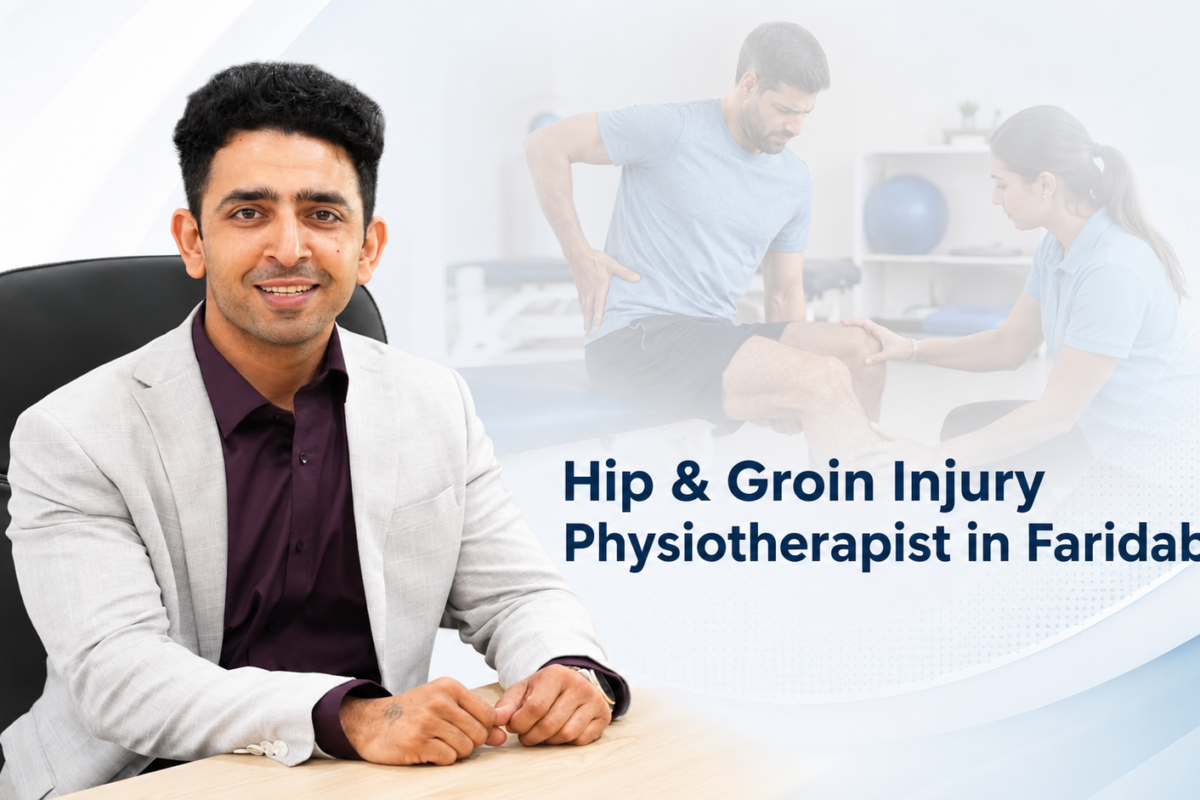
Hip and groin pain can limit sprinting, kicking, running, squatting and even prolonged sitting. Symptoms may involve the adductors, hip flexors, gluteal muscles, tendons or the hip joint itself. Because several structures can create similar pain patterns, physiotherapy should be based on a thorough examination of strength, movement, load history and sport-specific demands. If you are looking for a Hip & Groin Injury Physiotherapist in Faridabad, the goal should be to understand why the problem developed, identify which movements are currently limited and rebuild capacity safely instead of focusing only on short-term pain relief.
For people searching for the best Sports Physiotherapist in Faridabad, Dr. Sandeep Hooda provides a sports-oriented approach to hip and groin injury rehabilitation that focuses on assessment, progressive exercise, movement quality and a planned return to activity. The rehabilitation process is designed around the individual rather than only the diagnosis, so the program can reflect age, sport, work demands, current fitness, previous injuries and the level of performance the person wants to regain.
Hip and groin rehabilitation should be progressive and specific. Adductor strength, sprint exposure and change-of-direction capacity often need to be rebuilt before an athlete is truly ready for full training. Treatment with a Hip & Groin Injury Physiotherapist in Faridabad may include pain and load management, mobility work where required, progressive strengthening, balance and control exercises, running or agility progression and clear home-exercise guidance. The aim is to help the hip and groin tolerate real-life and sporting demands again, not simply feel better during a clinic session.
What Is a Hip and Groin Injury and Why Does It Need Proper Rehabilitation?
A hip or groin injury is not always defined by one single tissue. In many people, pain and loss of function are influenced by a combination of tissue irritation, reduced strength, altered movement, sudden workload changes and incomplete recovery from a previous problem.
That is why treatment from a Hip & Groin Injury Physiotherapist in Faridabad should begin by identifying the main limiting factors rather than assuming that every person with the same diagnosis needs exactly the same exercises.
For footballers, runners, cricketers, gym-goers, dancers and active adults, the practical impact can be significant. Hip or groin pain may reduce training volume, force changes in technique, make work difficult or create hesitation during movements that were previously automatic.
The longer someone compensates, the more likely it is that strength, endurance and confidence decline. Physiotherapy aims to interrupt that cycle with a progressive and measurable rehabilitation plan.
Common Causes of Hip and Groin Injury
Hip and groin injuries may occur suddenly or develop gradually due to repeated physical loading.
Common contributing situations include:
- Sprinting, kicking or rapid direction changes.
- Sudden stretch under load.
- High-volume running or field training.
- Heavy squats, lunges or lateral movements.
- Reduced adductor or hip strength.
- Rapid return to sport after a previous groin problem.
In many sports injuries, the final painful event is only one part of the overall picture. Training load, recovery, fatigue, previous injuries and movement demands during the preceding weeks can also influence how the hip and groin respond.
A detailed history helps connect symptoms with changes in training or daily activity.
For example, an athlete may tolerate the same movement for months but develop symptoms after increasing training volume, intensity, frequency or competition exposure.
Understanding this relationship allows a Hip & Groin Injury Physiotherapist in Faridabad to temporarily modify the activities creating excessive stress while continuing safe physical activity wherever possible.
Symptoms That May Need a Hip & Groin Injury Physiotherapist in Faridabad
People often seek physiotherapy when symptoms begin to interfere with daily function, exercise or sporting performance rather than because of pain alone.
Typical features may include:
- Pain in the groin or front or side of the hip.
- Pain with sprinting, kicking or cutting.
- Discomfort during squats or lunges.
- Stiffness after sitting or training.
- Weakness during side-to-side movement.
- Recurring symptoms when training intensity increases.
The exact pattern varies according to the involved structure, severity, irritability and the demands placed on the hip and groin.
Some symptoms require medical assessment before or alongside physiotherapy, particularly after significant trauma, suspected fracture or dislocation, progressive neurological symptoms, unexplained fever or illness, severe unrelenting night pain or sudden loss of normal function.
A responsible rehabilitation plan should include appropriate referral whenever the presentation does not fit a routine sports or musculoskeletal problem.
How Physiotherapy Assessment Works for Hip and Groin Injury
A useful physiotherapy assessment combines the injury history with objective physical testing.
Depending on the presentation, Dr. Sandeep Hooda may assess:
- Hip range of movement.
- Adductor strength.
- Hip flexor strength.
- Gluteal strength and capacity.
- Trunk and pelvic control.
- Single-leg squat mechanics.
- Change-of-direction movement.
- Running mechanics.
- Kicking demands.
- Response to specific loading tests.
The purpose is to identify what is painful, what is weak, what is restricted and which movement tasks need to be restored according to the person’s actual goals.
Assessment should also consider the training environment.
Weekly training volume, sudden increases in intensity, competition schedule, gym programming, footwear, playing surface, sleep, recovery and previous injuries can all influence how the body responds to load.
For athletes, video-based review of selected movement tasks may also help identify control issues, asymmetry or technique changes that are difficult to appreciate from symptoms alone.
The initial assessment establishes a baseline.
Re-testing during rehabilitation is important because progress should be measurable. Improvements in range of motion, strength, balance, repeated-effort capacity, running tolerance and sport-specific tasks can help determine when to progress and when further rehabilitation is needed.
Treatment Approach by a Hip & Groin Injury Physiotherapist in Faridabad
The main rehabilitation priorities are to manage irritability, restore comfortable hip motion, strengthen the adductors and gluteal muscles, improve trunk and pelvic control, progress running and cutting loads and rebuild kicking or high-speed sport demands when required.
The exact sequence depends on the injury, symptom irritability and stage of recovery.
Early treatment may focus on comfortable movement and symptom management, while later rehabilitation should become progressively more challenging so the hip and groin are prepared for the forces experienced during work, exercise and sport.
1. Education and Load Management
Understanding which activities aggravate the hip or groin injury and which can safely continue helps prevent unnecessary complete rest.
Training may temporarily be modified by adjusting:
- Volume.
- Running speed.
- Movement depth.
- Resistance.
- Training surface.
- Frequency.
The aim is to reduce excessive irritation while preserving fitness, strength and confidence wherever possible.
2. Mobility and Movement Restoration
If movement around the hip or groin is restricted, targeted mobility work may be used to regain the range required for walking, squatting, lifting, running or sport.
Mobility is not pursued simply to achieve a larger range number.
It should improve function and help the individual perform important activities with less stiffness or compensation.
3. Progressive Strength Training
Strength is one of the most important foundations of hip and groin rehabilitation.
Exercises are selected according to the individual’s assessment and progressed through suitable:
- Resistance.
- Range.
- Tempo.
- Repetitions.
- Sets.
- Training volume.
The goal is to improve the capacity of the adductors, hip muscles and surrounding muscle groups so everyday and sport-specific forces become manageable again.
4. Balance, Coordination and Control
Hip and groin injuries can affect confidence and automatic movement control.
Rehabilitation may include:
- Single-leg exercises.
- Balance drills.
- Controlled lateral movements.
- Landing exercises.
- Change-of-direction drills.
- Trunk and pelvic control exercises.
These exercises help bridge the gap between isolated strengthening and the unpredictable movements required during everyday activity and sport.
5. Power, Speed and Sport-Specific Reconditioning
Once adequate foundational strength has been restored, athletes often need faster and more demanding loading.
Rehabilitation may progressively introduce:
- Running.
- Sprinting.
- Acceleration.
- Deceleration.
- Cutting.
- Kicking.
- Jumping.
- Repeated-effort work.
- Sport-specific movement patterns.
This stage is important because the hip and groin may feel comfortable during slow gym exercises but still be underprepared for the speed and forces experienced during sport.
A Phase-Wise Rehabilitation Plan
Phase 1: Settle Irritability and Protect Function
The initial goal is to reduce unnecessary aggravation without creating excessive fear of movement or physical deconditioning.
Activities are adjusted according to symptoms, while early exercises maintain safe hip movement and muscle activation.
Phase 2: Restore Range and Foundational Strength
As symptoms become more stable, the rehabilitation program gradually becomes more challenging.
Strength exercises become more systematic and mobility limitations that genuinely affect function are addressed.
Walking, stairs, sitting and routine daily activities should gradually become easier and more predictable.
Phase 3: Build Capacity for the Person’s Real Demands
Rehabilitation now becomes increasingly specific to the person’s work, gym or sporting requirements.
Resistance, repetitions, movement speed, single-leg demand and movement complexity are progressively increased so the hip and groin develop sufficient reserve capacity for repeated loading.
Phase 4: Return to Running, Sport or Higher-Level Activity
This stage introduces the movements and activities the person ultimately wants to perform.
Running, sprinting, kicking, cutting and sport-specific movements may be progressively reintroduced where appropriate.
Progression should be based on tolerance and objective readiness rather than simply attempting full-intensity activity and hoping symptoms do not return.
Phase 5: Reduce Recurrence Risk
Before discharge, the patient should understand a long-term maintenance strategy.
Continued strength training, sensible workload progression, appropriate warm-up habits and early management of recurring symptoms can help protect the progress achieved during rehabilitation.
Why Sports-Specific Physiotherapy Matters
Sports physiotherapy involves more than stopping treatment when pain decreases.
For footballers, runners, cricketers, gym-goers, dancers and active adults, the hip and groin must tolerate repeated force, speed, fatigue and rapid changes in direction.
A person may successfully perform a basic clinic exercise but still struggle with:
- Sprinting.
- Kicking.
- Jumping.
- Heavy lifting.
- Cutting.
- Rapid direction changes.
- High-speed running.
- Repeated efforts late in training or competition.
Rehabilitation should therefore progress from basic strength and control to the actual performance demands that matter.
As a Hip & Groin Injury Physiotherapist in Faridabad, Dr. Sandeep Hooda’s sports-focused approach may use objective progress markers rather than relying only on pain scores.
Depending on the injury, these may include:
- Adductor strength comparisons.
- Hip strength testing.
- Controlled squats.
- Single-leg exercises.
- Running tolerance.
- Sprint exposure.
- Change-of-direction drills.
- Kicking tolerance.
- Sport-specific movement tasks.
Objective milestones can make return-to-activity decisions clearer and reduce unnecessary guesswork.
Home Exercise Program for Hip and Groin Injury
A home-exercise program is most effective when it is simple enough to follow consistently and specific enough to create meaningful improvement.
Instead of prescribing a long list of unrelated exercises, the rehabilitation plan should prioritise the movements that address the main deficits identified during assessment.
Repetitions, resistance, frequency and progression should be clearly explained.
For hip and groin injuries, home exercises may include:
- Mobility exercises.
- Adductor strengthening.
- Hip flexor strengthening.
- Gluteal strengthening.
- Progressive resistance exercises.
- Single-leg control exercises.
- Balance and coordination drills.
- Graded exposure to previously difficult movements.
The exercise program should progress as strength, control and physical capacity improve.
Continuing the same easy exercises for several weeks after they stop being challenging is unlikely to adequately prepare an athlete for sprinting, kicking, cutting or higher-level sporting demands.
Return to Running, Gym or Sport: What Should Be Checked?
A safe return to activity is usually gradual.
The first session back should not automatically match pre-injury volume or intensity.
Instead, training can be reintroduced progressively while monitoring the response during activity, later the same day and the following morning.
Important factors may include:
- Near-normal movement required for the activity.
- Adequate hip and adductor strength.
- Good single-leg control.
- Confidence during sport-specific tasks.
- Ability to tolerate progressive running, sprinting, kicking or cutting loads.
- No significant increase in symptoms following progression.
- A clear plan for increasing weekly training load.
For competitive athletes, return to sport may also include progressive practice exposure before full competition.
Training volume, non-contact drills, controlled contact, position-specific tasks, high-speed running exposure and match minutes may be staged so the athlete develops both physical and psychological readiness.
How to Help Prevent Another Hip and Groin Injury
The following strategies may help reduce avoidable risk factors:
- Increase training load gradually instead of making sudden jumps in distance, speed, resistance or frequency.
- Maintain adductor, hip and gluteal strength even after symptoms have settled.
- Continue single-leg and lateral control exercises where appropriate.
- Use warm-up drills that prepare the movements and speeds required during the upcoming activity.
- Plan sufficient recovery between demanding running or field-training sessions.
- Avoid repeatedly stacking high-load sessions when fatigue is high.
- Respond early to recurring pain, stiffness, weakness or reduced performance.
- Continue late-stage rehabilitation long enough to restore sport-specific power, speed, endurance and confidence.
Prevention does not guarantee that another injury will never occur.
Sport always carries some level of risk.
The practical goal is to improve physical capacity, movement control and workload management so the hip and groin are better prepared for the demands placed on them.
Why Choose Dr. Sandeep Hooda as a Hip & Groin Injury Physiotherapist in Faridabad?
People searching online for a Hip & Groin Injury Physiotherapist in Faridabad or the best Sports Physiotherapist in Faridabad usually want more than temporary pain relief.
They want to understand the injury, regain strength, return confidently to activity and reduce the chance of recurring hip or groin symptoms repeatedly interrupting training.
Dr. Sandeep Hooda’s sports-focused rehabilitation approach emphasises individual assessment, progressive exercise, performance-oriented loading and structured return-to-activity planning for hip and groin injuries.
The rehabilitation program can be adapted for athletes as well as non-athletes.
A competitive footballer may require advanced sprinting, kicking and cutting rehabilitation, while a runner may need progressive running-load management. An office professional may need to regain confidence with walking, stairs, sitting, lifting or gym training.
The principle remains the same: rehabilitation should match the level of function the person actually needs.
Frequently Asked Questions About Hip & Groin Injury Physiotherapist in Faridabad
1. How long does hip and groin injury physiotherapy take?
Recovery time depends on the diagnosis, injury severity, duration of symptoms, previous injuries and the activity you want to return to.
Mild muscle problems may improve over a shorter period, while significant muscle, tendon, joint-related or post-operative conditions may require a longer progressive rehabilitation process.
Rather than focusing only on a fixed timeline, progress should be assessed through improvements in movement, strength and load tolerance.
2. Should I stop all exercise if I have a hip or groin injury?
Not always.
Complete rest may temporarily reduce symptoms, but it can also contribute to loss of strength and fitness.
Many people can continue appropriately modified activity that does not significantly aggravate symptoms.
The safest level depends on individual assessment, while significant trauma or unusual symptoms should be medically evaluated.
3. Will physiotherapy only include machines or passive treatment?
A sports-focused rehabilitation program usually places active exercise at the centre of treatment.
Manual therapy or other symptom-relief techniques may be used when appropriate, but long-term recovery depends on restoring movement, strength, coordination and tolerance to the activities you need to perform.
4. When can I return to running or gym training?
Return should be based on symptoms, strength, movement quality and the ability to tolerate progressive loading.
Rather than moving immediately from rest to full training, rehabilitation should use graded exposure so the hip and groin can adapt and their response can be monitored.
5. Can an old hip or groin injury still improve with physiotherapy?
Yes, many persistent problems can improve when the factors currently limiting function are identified and progressively trained.
A previous hip or groin injury may leave weakness, reduced endurance, altered movement confidence or poor tolerance to higher-level activity even after the initial injury has healed.
6. Do I need an MRI before starting physiotherapy?
Not every hip or groin problem requires imaging before rehabilitation.
Clinical assessment is often useful for determining the initial management plan.
Imaging may be recommended when the history or examination suggests a significant structural problem or another condition requiring further medical investigation.
7. What should I bring to my first physiotherapy visit?
Bring any relevant medical reports, prescriptions or scans if you already have them.
It is also helpful to know:
- How the injury started.
- When symptoms began.
- Which movements aggravate the problem.
- Previous hip or groin injuries.
- Recent changes in running or sporting workload.
- Your current training level.
- The activity or sport you want to return to.
Sports footwear and clothing that allows movement assessment can also be helpful when running, squatting, lunging or sport-specific testing is required.
8. Is a Hip & Groin Injury Physiotherapist in Faridabad useful only for athletes?
No.
Although sports physiotherapy principles are highly relevant to athletes, the same rehabilitation approach can help active adults who want to walk, work, travel, sit comfortably, exercise or use the gym without recurring hip or groin problems.
The rehabilitation program is simply adapted to the person’s goals and current physical capacity.
Book an Assessment with a Hip & Groin Injury Physiotherapist in Faridabad
If a hip or groin injury is limiting your daily activities, running, gym training or sporting performance, a functional physiotherapy assessment can help identify what needs to improve.
A structured rehabilitation program should provide a clear understanding of the problem, measurable goals and a progression from symptom management to strength development and full activity.
If you are looking for a Hip & Groin Injury Physiotherapist in Faridabad, consult Dr. Sandeep Hooda for an individualized sports physiotherapy and return-to-performance rehabilitation plan in Faridabad.