
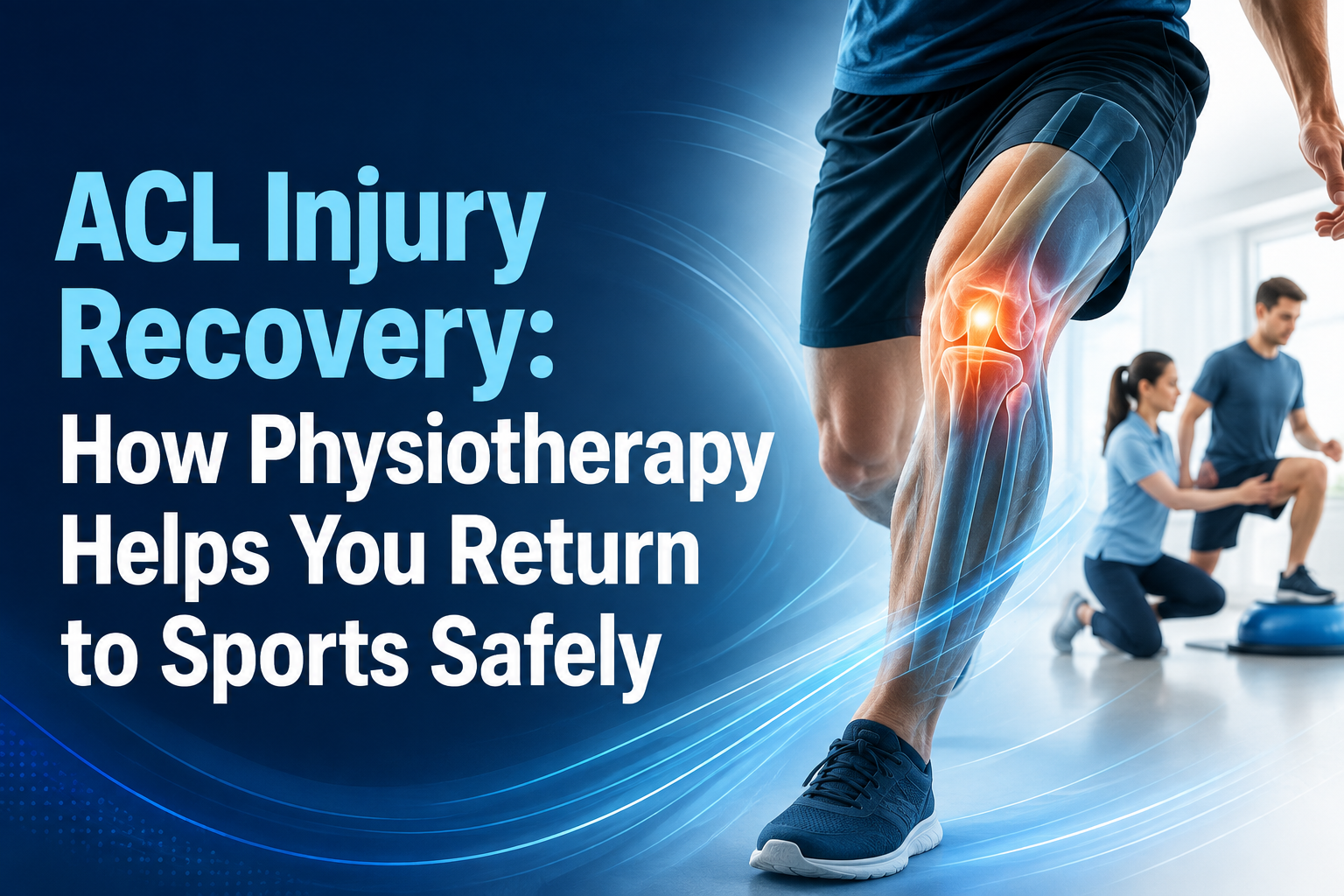
An ACL injury can be one of the most challenging setbacks for an athlete or physically active person. Whether the injury happens while playing football, cricket, basketball, badminton, kabaddi, running, or during a sudden twisting movement, damage to the anterior cruciate ligament can significantly affect knee stability, strength, confidence, and sports performance.
The encouraging part is that an ACL injury does not necessarily mean the end of your sporting activities. With an accurate diagnosis, appropriate medical management, structured physiotherapy, progressive strengthening, and sport-specific rehabilitation, many people can safely return to an active lifestyle and competitive sports.
Physiotherapy plays a central role throughout the ACL injury recovery process—whether the injury is treated conservatively or through ACL reconstruction surgery. Rehabilitation is not simply about reducing knee pain. It focuses on restoring mobility, rebuilding muscle strength, improving balance and control, retraining sports movements, and preparing the knee to tolerate the demands of your chosen sport.
For athletes looking for the best Sports Physiotherapist in Faridabad, working with an experienced professional such as Dr. Sandeep Hooda can help ensure that ACL rehabilitation follows a structured, progressive, and sports-focused approach.
What Is an ACL Injury?
The ACL, or Anterior Cruciate Ligament, is one of the major ligaments inside the knee joint. It connects the thigh bone to the shin bone and plays an important role in maintaining knee stability, particularly during activities involving:
- Sudden changes in direction
- Pivoting or twisting
- Jumping and landing
- Rapid acceleration
- Sudden deceleration
- Cutting movements
- Running at speed
- Contact during sports
An ACL injury can range from a mild sprain to a partial or complete ligament tear.
ACL injuries are especially common in sports such as football, basketball, badminton, volleyball, skiing, kabaddi, athletics, and other activities that require frequent changes in direction.
Common Causes of ACL Injuries in Sports
Contrary to what many people believe, an ACL injury does not always require a direct collision. A significant number of ACL injuries occur without direct contact.
Common injury mechanisms include:
Sudden Change of Direction
Rapidly changing direction while the foot remains planted can create excessive rotational force across the knee.
Incorrect Landing After a Jump
Landing with poor knee or hip control can place additional stress on the ACL.
Sudden Stopping
Quick deceleration during running or sports can increase forces through the knee joint.
Twisting the Knee
Pivoting while the foot remains fixed on the ground is a common mechanism of ACL injury.
Direct Impact
A collision during contact sports can force the knee into an abnormal position and potentially damage the ligament.
Understanding how an injury occurred is important because ACL rehabilitation should not only treat the injured knee—it should also address movement patterns that may have contributed to the injury.
Symptoms of an ACL Injury
ACL injury symptoms may vary according to the severity of the tear. Common symptoms include:
- A popping sensation or sound at the time of injury
- Sudden knee pain
- Rapid swelling
- Difficulty continuing sports
- Reduced range of motion
- Difficulty walking normally
- A feeling that the knee is unstable
- The knee giving way during movement
- Difficulty changing direction
- Reduced confidence while running or jumping
Anyone experiencing these symptoms after a sports injury should seek appropriate clinical assessment rather than attempting to continue playing through the pain.
Does Every ACL Injury Require Surgery?
Not necessarily.
Treatment depends on several factors, including:
- Whether the ACL is partially or completely torn
- Presence of associated meniscus or cartilage injuries
- Age
- Activity level
- Knee stability
- Type of sport
- Occupation
- Future sporting goals
- Frequency of knee instability
- Overall health
Some individuals may manage an ACL injury successfully with structured physiotherapy and activity modification.
Others—particularly athletes involved in high-demand pivoting sports—may be advised to undergo ACL reconstruction surgery after evaluation by an orthopaedic or sports medicine specialist.
Regardless of whether surgery is performed, physiotherapy remains one of the most important components of ACL recovery.
Why Physiotherapy Is Essential After an ACL Injury
ACL rehabilitation is much more than performing a few knee exercises.
An effective physiotherapy program is designed to progressively restore the physical abilities required for normal movement and eventually for sports.
The major goals include:
- Controlling pain and swelling
- Restoring full knee movement
- Normalizing walking
- Rebuilding quadriceps strength
- Strengthening hamstrings and gluteal muscles
- Improving balance
- Restoring neuromuscular control
- Improving jumping and landing technique
- Retraining agility
- Developing sport-specific strength
- Reducing the risk of re-injury
- Preparing the athlete physically and psychologically for return to sport
This structured progression is why consultation with a Sports Physiotherapist in Faridabad can be particularly valuable for athletes who want to safely return to their previous level of activity.
Stages of ACL Injury Recovery Through Physiotherapy
ACL rehabilitation progresses through several phases. The exact timeline varies from person to person, so progression should ideally be based on clinical milestones rather than only the number of weeks since injury or surgery.
Phase 1: Reducing Pain and Swelling
The initial priority is to settle the irritated knee.
Physiotherapy may focus on:
- Swelling management
- Pain reduction
- Gentle knee movement
- Restoring knee extension
- Improving quadriceps activation
- Safe weight-bearing
- Correct walking pattern
- Appropriate home exercises
One of the early challenges after an ACL injury or reconstruction is weakness or reduced activation of the quadriceps muscle.
Restoring quadriceps function early is important for normal walking and later stages of rehabilitation.
Patients should avoid aggressively increasing exercises before pain and swelling are adequately controlled.
Phase 2: Restoring Knee Range of Motion
A healthy knee requires adequate bending and straightening.
Physiotherapy progressively works toward restoring functional knee movement through individually prescribed mobility exercises and controlled strengthening.
Achieving good knee extension is particularly important because persistent loss of extension can affect walking mechanics and quadriceps function.
The physiotherapist monitors:
- Knee flexion
- Knee extension
- Swelling
- Muscle control
- Walking pattern
- Pain levels
Rehabilitation is adjusted according to the patient’s progress.
Phase 3: Rebuilding Muscle Strength
Once pain, swelling, movement, and basic walking improve, strengthening becomes a major focus.
An ACL injury does not affect only the ligament. Periods of pain, swelling, reduced activity, and surgery can lead to loss of muscle strength throughout the lower limb.
A structured program may target:
Quadriceps
Strong quadriceps are essential for knee control, running, jumping, and absorbing forces.
Hamstrings
The hamstrings contribute to knee stability and help control movement of the shin bone.
Gluteal Muscles
Hip strength plays a major role in controlling the position of the knee during running, landing, and direction changes.
Calf Muscles
Strong calf muscles contribute to running, jumping, acceleration, and overall lower-limb function.
Core Muscles
Core stability supports body control and helps athletes maintain proper movement mechanics during sports.
Exercises are gradually progressed according to strength, control, pain, swelling, and rehabilitation goals.
Balance and Proprioception Training After ACL Injury
Proprioception refers to the body’s ability to understand the position and movement of a joint without constantly looking at it.
After an ACL injury, this neuromuscular control may be affected.
Balance and proprioceptive exercises can therefore form an important part of rehabilitation.
Training may progress from simple controlled activities to more demanding tasks involving:
- Single-leg balance
- Dynamic stability
- Direction changes
- Reaching exercises
- Controlled unstable surfaces where appropriate
- Reactive movements
- Sport-related balance challenges
The goal is to improve the body’s ability to automatically control the knee during unpredictable sporting situations.
Learning to Jump and Land Safely
Being able to jump does not automatically mean an athlete is ready to return to sport.
Landing technique is extremely important.
Poor landing mechanics may include excessive inward movement of the knee, poor hip control, inadequate shock absorption, or asymmetry between the legs.
Sports physiotherapy can help athletes retrain:
- Double-leg landing
- Single-leg landing
- Forward jumps
- Lateral jumps
- Repeated hops
- Deceleration
- Controlled absorption of force
Movement quality is assessed alongside performance.
An athlete who can jump high but cannot control the knee during landing may still require further rehabilitation.
When Can You Start Running After an ACL Injury?
One of the most common questions during rehabilitation is:
“When can I start running again?”
There is no universal answer.
Starting running should depend on factors such as:
- Knee swelling
- Pain
- Range of motion
- Quadriceps strength
- Single-leg control
- Walking mechanics
- Ability to perform basic strengthening exercises
- Clinical assessment by the rehabilitation team
Running too early may overload a knee that is not adequately prepared.
A Sports Physiotherapist can progressively introduce walking, jogging, running, acceleration, and later sprinting depending on the athlete’s recovery.
Agility Training and Change-of-Direction Exercises
Returning to jogging is only one milestone.
Many sports require far more demanding movements, including:
- Sprinting
- Cutting
- Side stepping
- Pivoting
- Sudden stopping
- Rapid acceleration
- Backward running
- Reactive direction changes
These movements place considerably greater demands on the knee than straight-line jogging.
Agility exercises are therefore introduced gradually after the athlete demonstrates adequate strength, balance, and movement control.
A structured sports rehabilitation program recreates the physical demands of sport progressively rather than immediately sending the athlete back into full competition.
Sport-Specific Rehabilitation Is Essential
A football player and a long-distance runner should not follow exactly the same return-to-sport program.
Similarly, a badminton player has different movement demands compared with a cricketer or basketball player.
Sport-specific physiotherapy considers:
- Playing position
- Acceleration demands
- Direction changes
- Jump frequency
- Landing patterns
- Sprinting requirements
- Endurance requirements
- Contact situations
- Training volume
- Competition intensity
For example, a footballer may need extensive cutting, sprinting, ball-control, reactive agility, and deceleration drills.
A badminton player may require repeated lunges, rapid lateral movements, jumps, and multi-directional footwork.
A cricket player may need different rehabilitation depending on whether they are a bowler, batter, wicketkeeper, or fielder.
This individualized planning is one of the reasons athletes should consider consulting an experienced sports rehabilitation professional.
Return-to-Sport Testing After ACL Rehabilitation
One of the biggest mistakes after ACL recovery is returning to sports simply because a certain number of months have passed.
Time is important—but time alone does not determine whether an athlete is ready.
A comprehensive return-to-sport assessment may consider:
- Knee range of motion
- Swelling
- Quadriceps strength
- Hamstring strength
- Strength symmetry
- Single-leg control
- Hop performance
- Jump and landing mechanics
- Agility
- Running ability
- Sport-specific movements
- Confidence
- Psychological readiness
The decision to return to sport should ideally involve the athlete, physiotherapist, surgeon or treating physician, and other relevant members of the sports medicine team.
Why Returning to Sports Too Early Can Be Risky
Athletes are often eager to return as quickly as possible.
However, returning before adequate rehabilitation can increase the risk of problems such as:
- Recurrent instability
- Poor movement mechanics
- Reduced performance
- Compensatory injuries
- Loss of confidence
- Re-injury to the knee
- Injury to the opposite knee
Feeling “normal” during daily activities is very different from being prepared for competitive sports.
Walking, climbing stairs, jogging, sprinting, cutting, tackling, jumping, landing, and reacting to an opponent all place progressively greater demands on the body.
Safe rehabilitation prepares the athlete for these demands in stages.
Psychological Recovery After ACL Injury
ACL recovery is not purely physical.
Many athletes experience fear when they begin returning to movements associated with their original injury.
They may hesitate while:
- Jumping
- Landing
- Turning
- Tackling
- Sprinting
- Cutting
- Performing single-leg movements
Fear of re-injury can affect movement quality and sports performance.
Progressive exposure to sport-specific activities can help athletes rebuild confidence alongside physical ability.
A good rehabilitation program therefore considers not just whether the knee is strong enough, but whether the athlete trusts the knee during demanding situations.
Can Physiotherapy Help Prevent Another ACL Injury?
No rehabilitation program can guarantee that an ACL injury will never happen again.
However, physiotherapy can address several modifiable factors that may help reduce injury risk.
Prevention-focused training may include:
- Lower-limb strengthening
- Hip strengthening
- Hamstring conditioning
- Neuromuscular training
- Jump-landing technique
- Balance exercises
- Deceleration training
- Movement-control exercises
- Agility training
- Appropriate warm-up routines
- Gradual workload progression
These exercises can be particularly valuable for athletes involved in sports with frequent jumping, pivoting, or sudden direction changes.
Common Mistakes During ACL Recovery
Stopping Physiotherapy Once Pain Reduces
Reduced pain does not mean that strength and sports readiness have fully returned.
Doing Only Basic Knee Exercises
Sports rehabilitation needs to progress beyond simple knee bending and strengthening exercises.
Comparing Your Recovery With Another Athlete
Every injury, surgery, body, sport, and rehabilitation response is different.
Returning to Sport Based Only on Time
Functional ability and objective rehabilitation milestones should also be considered.
Ignoring Hip and Core Strength
Knee control is influenced by the entire lower-limb movement chain.
Avoiding Single-Leg Training
Many sporting movements depend heavily on single-leg strength and control.
Skipping Sport-Specific Rehabilitation
Gym strength does not automatically translate into readiness for competitive sports.
Dr. Sandeep Hooda – Best Sports Physiotherapist in Faridabad for ACL Rehabilitation
Recovering from an ACL injury requires more than temporary pain relief. Athletes need a rehabilitation program that considers their strength, movement mechanics, sporting demands, recovery stage, and long-term goals.
For people searching for the best Sports Physiotherapist in Faridabad, Dr. Sandeep Hooda provides a sports-focused approach to rehabilitation aimed at helping patients regain movement, improve strength, rebuild confidence, and progress toward a safe return to physical activity.
ACL rehabilitation may include:
- Detailed functional assessment
- Personalized rehabilitation planning
- Pain and swelling management
- Range-of-motion exercises
- Progressive strengthening
- Balance and proprioception training
- Running progression
- Jump and landing retraining
- Agility exercises
- Sport-specific rehabilitation
- Return-to-sport preparation
- Injury-prevention guidance
The objective should not simply be to return an athlete to the field quickly. The objective is to help them return prepared, confident, strong, and capable of managing the physical demands of their sport.
Choosing an experienced Sports Physiotherapist in Faridabad can therefore make an important difference during the journey from injury to performance.
How Long Does ACL Recovery Take?
There is no identical ACL recovery timeline for every patient.
Recovery depends on:
- Severity of the injury
- Surgical or non-surgical treatment
- Associated injuries
- Muscle strength before injury
- Rehabilitation consistency
- Age
- Training history
- Type of sport
- Individual healing
- Psychological readiness
- Progress during functional testing
Some milestones may happen relatively early, while return to high-demand competitive sport can require a much longer rehabilitation process.
Patients should therefore avoid treating ACL rehabilitation as a race.
Quality of recovery is more important than simply reaching a particular date.
When Should You Consult a Sports Physiotherapist?
Consider professional assessment if you have:
- Knee pain after a sports injury
- Swelling after twisting the knee
- Difficulty bending or straightening the knee
- A feeling that the knee is unstable
- Repeated episodes of the knee giving way
- Weakness after ACL surgery
- Difficulty returning to running
- Fear while jumping or changing direction
- Reduced sports performance after an ACL injury
Early assessment can help identify appropriate rehabilitation goals and prevent unnecessary delays in recovery.
Final Thoughts
An ACL injury can temporarily take you away from the sport you love, but recovery should focus on much more than simply waiting for the ligament or surgical reconstruction to heal.
Successful ACL injury recovery requires a structured rehabilitation process that restores mobility, strength, balance, coordination, movement quality, agility, confidence, and sports-specific performance.
Physiotherapy helps bridge the important gap between being able to perform everyday activities and being physically ready for the unpredictable demands of competitive sport.
If you are recovering from an ACL injury or ACL reconstruction and looking for the best Sports Physiotherapist in Faridabad, consulting Dr. Sandeep Hooda can help you follow a structured sports rehabilitation program focused on safe and progressive recovery.
Recover stronger. Move with confidence. Return to your sport safely.
Frequently Asked Questions About ACL Injury Recovery
1. Can an ACL injury heal without surgery?
Some ACL injuries can be managed without surgery, depending on the severity of the injury, knee stability, activity requirements, associated injuries, and individual goals. An orthopaedic or sports medicine assessment is recommended to determine the appropriate treatment approach.
2. Is physiotherapy necessary after ACL surgery?
Yes. Physiotherapy is a fundamental part of rehabilitation following ACL reconstruction. It helps restore knee movement, muscle strength, balance, functional control, and eventually sports-specific performance.
3. When can I walk normally after ACL surgery?
The timeline varies according to the surgical procedure, associated injuries, surgeon’s protocol, swelling, muscle control, and individual recovery. Walking progression should follow professional advice.
4. When can I start running after an ACL injury?
Running should begin after appropriate rehabilitation milestones have been achieved rather than simply according to a fixed date. Knee mobility, strength, swelling, control, and functional ability should be assessed first.
5. Can I play football again after an ACL tear?
Many athletes return to football after ACL rehabilitation. However, football requires sprinting, cutting, pivoting, tackling, and rapid direction changes, so comprehensive sport-specific rehabilitation and return-to-sport assessment are important.
6. How can I strengthen my knee after an ACL injury?
Exercises may focus on the quadriceps, hamstrings, glutes, calves, core, balance, and functional movement patterns. The program should progress according to your stage of recovery and clinical assessment.
7. Why is sports physiotherapy important after ACL injury?
Sports physiotherapy prepares the athlete for movements beyond everyday activities. Rehabilitation can include running, jumping, landing, agility, deceleration, cutting, reactive movements, and sport-specific drills.
8. How do I know when I am ready to return to sports?
Readiness is usually assessed through a combination of strength, functional performance, movement quality, knee symptoms, sport-specific ability, confidence, and clinical evaluation.
9. Who should I consult for ACL rehabilitation in Faridabad?
For athletes seeking structured ACL and sports rehabilitation, Dr. Sandeep Hooda, Sports Physiotherapist in Faridabad, can provide an individualized rehabilitation approach based on recovery stage and sporting goals.
10. Can ACL injuries happen again after recovery?
Re-injury is possible, particularly if an athlete returns before adequate strength, control, confidence, and sport-specific ability have been restored. A structured rehabilitation and injury-prevention program can help address modifiable risk factors.