
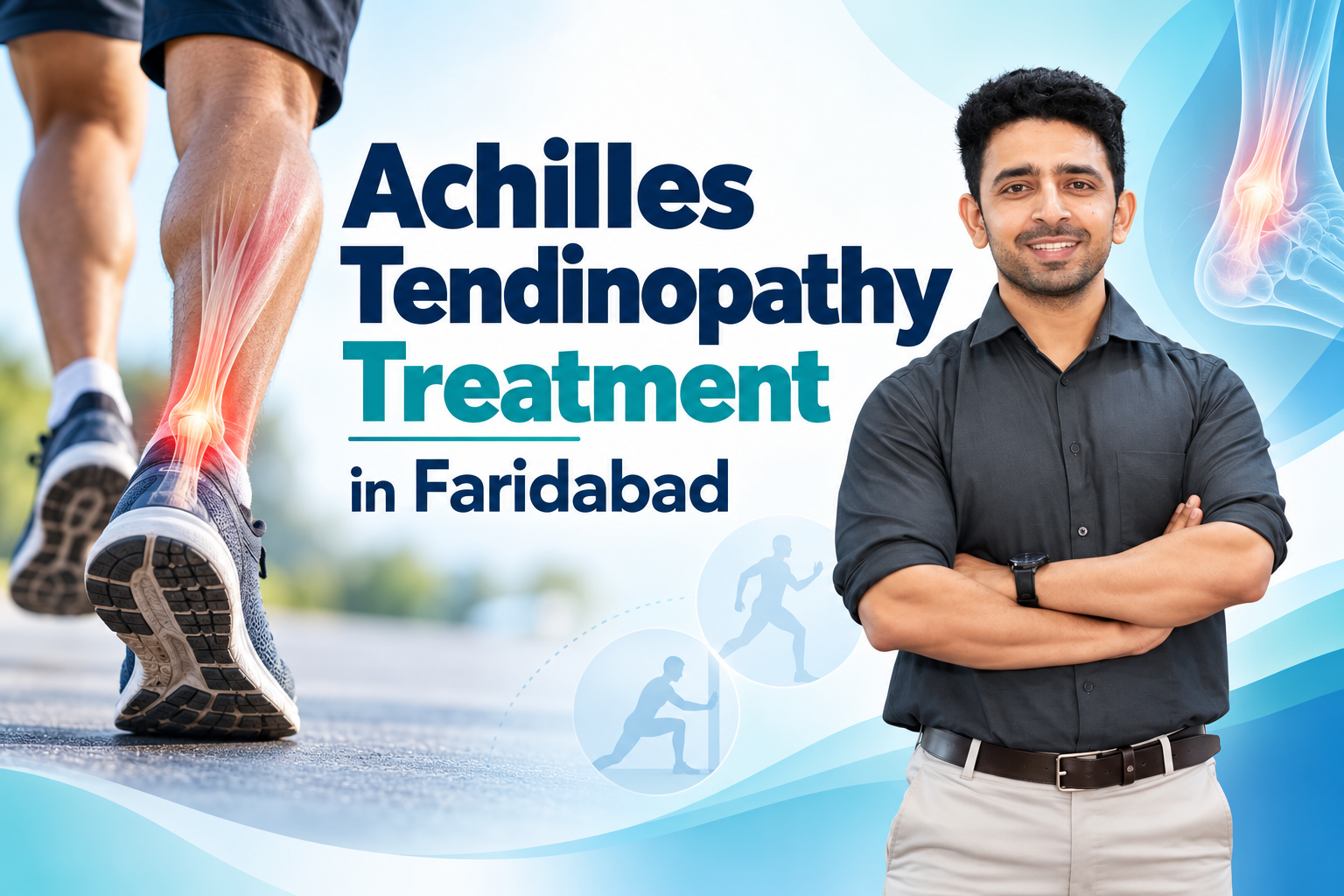
Achilles tendon pain can make everyday activities like walking, climbing stairs, running, and exercising uncomfortable. Whether you are a professional athlete, a recreational runner, a gym enthusiast, or someone who spends long hours standing, persistent pain at the back of your ankle can affect your mobility and quality of life.
One of the most common causes of this discomfort is Achilles tendinopathy, a condition that develops when the Achilles tendon struggles to tolerate repeated physical stress.
If you are looking for Achilles Tendinopathy Treatment in Faridabad, understanding the causes, symptoms, and available physiotherapy treatments can help you make informed decisions about your recovery.
Dr. Sandeep Hooda, the best sports physiotherapist in Faridabad with over 13 years of clinical experience, offers assessment-led sports injury rehabilitation focused on progressive strengthening, movement improvement, and returning patients to their desired physical activities. His approach emphasises restoring tendon capacity rather than relying solely on temporary pain relief.
With timely assessment, appropriate load management, and a structured rehabilitation programme, many patients with Achilles tendinopathy can improve their symptoms and return to their usual activities without surgery.
What Is Achilles Tendinopathy?
Achilles tendinopathy is a painful condition affecting the Achilles tendon, the strong band of connective tissue that connects the calf muscles to the heel bone.
The Achilles tendon plays an essential role in walking, running, jumping, climbing stairs, and standing on your toes. It transfers force generated by the calf muscles to the foot, allowing efficient movement and propulsion.
However, when the tendon experiences repeated stress beyond its current capacity, it may develop pain, stiffness, thickening, and reduced load tolerance.
Achilles tendinopathy is often associated with running and other high-impact sports, but it can also affect people who suddenly increase their walking, exercise, or daily physical activity.
The condition commonly develops gradually rather than following one specific injury.
Unlike an acute Achilles tendon rupture, tendinopathy usually develops through repeated loading and changes in tendon function over time.
Types of Achilles Tendinopathy
There are two primary types of Achilles tendinopathy:
1. Midportion Achilles Tendinopathy
This affects the middle section of the Achilles tendon, generally around 2–6 centimetres above the heel bone.
Common symptoms include discomfort during running, localised tenderness, tendon thickening, and morning stiffness.
2. Insertional Achilles Tendinopathy
This occurs where the Achilles tendon attaches directly to the heel bone.
Patients may experience pain near the back of the heel, irritation from footwear, and discomfort when walking uphill or climbing stairs.
Distinguishing between these two conditions is important because their rehabilitation exercises and loading strategies may differ.
Common Symptoms of Achilles Tendinopathy
Recognising the early warning signs can help prevent symptoms from becoming persistent.
Common symptoms include:
- Pain or tenderness at the back of the heel or ankle.
- Morning stiffness, particularly when taking the first few steps.
- Discomfort during running, jumping, or climbing stairs.
- Swelling or thickening around the Achilles tendon.
- Pain that improves after warming up but returns after activity.
- Reduced calf strength or difficulty performing heel raises.
- Increased soreness following intense physical activity.
- Discomfort when wearing shoes that press against the heel.
Symptoms may initially appear only after exercise. As the condition progresses, discomfort can become noticeable during routine walking or standing.
Persistent symptoms should not be ignored, particularly when they interfere with normal movement or athletic performance.
When Should You Seek Professional Help?
Consider consulting a sports physiotherapist if you experience recurring Achilles tendon pain, prolonged morning stiffness, or difficulty performing your regular physical activities.
Sudden severe pain, a popping sensation, or an inability to push off the affected foot may indicate an Achilles tendon rupture rather than routine tendinopathy. These symptoms require urgent medical assessment.
What Causes Achilles Tendinopathy?
Achilles tendinopathy usually develops when the physical demands placed on the tendon increase faster than its capacity to adapt.
Several factors may contribute to this imbalance.
1. Sudden Increase in Physical Activity
Rapidly increasing running distance, training frequency, sprinting, or exercise intensity can overload the Achilles tendon.
For example, a recreational runner who suddenly increases weekly mileage may experience tendon pain because the tissues have not had sufficient time to adapt.
2. Inadequate Recovery Between Workouts
Tendons need adequate recovery time between demanding activities.
Repeated high-impact exercise without sufficient recovery may contribute to persistent tendon irritation and reduced performance.
3. Calf Muscle Weakness
The calf muscles and Achilles tendon function together during movement.
Insufficient calf muscle strength and endurance may affect the ability to tolerate repetitive loading, particularly during running and jumping.
4. Footwear and Training Surface Changes
Changing footwear, switching running surfaces, or suddenly introducing hill training may increase mechanical demands on the Achilles tendon.
Footwear is only one contributing factor and should be evaluated alongside training load, strength, mobility, and overall biomechanics.
5. Previous Ankle or Foot Injuries
Previous injuries can sometimes affect movement patterns, strength, and loading behaviour.
Without appropriate rehabilitation, these limitations may contribute to repeated discomfort during sporting activities.
6. Other Contributing Factors
Age-related tendon changes, certain medical conditions, and medications such as fluoroquinolone antibiotics can influence tendon health. These factors should be considered during a clinical assessment.
How Is Achilles Tendinopathy Diagnosed?
An accurate diagnosis is essential before beginning treatment.
A sports physiotherapy assessment typically includes reviewing symptoms, understanding activity levels, identifying aggravating movements, and assessing tendon function.
Clinical History
The physiotherapist may ask about the location of pain, duration of symptoms, morning stiffness, changes in training intensity, and previous ankle injuries.
Information about work activities, footwear, running habits, and sports participation can also help identify contributing factors.
Physical Examination
The assessment may include:
- Palpation of the Achilles tendon.
- Ankle mobility evaluation.
- Calf muscle strength testing.
- Single-leg heel raise assessment.
- Walking and functional movement analysis.
- Balance and lower-limb control assessment.
- Sport-specific loading tests where appropriate.
Are Ultrasound or MRI Scans Necessary?
Achilles tendinopathy is frequently diagnosed through clinical history and physical examination.
Ultrasound or MRI may be considered when the diagnosis is uncertain, symptoms are unusual, a significant tear is suspected, or rehabilitation is not progressing as expected.
Imaging findings must be interpreted alongside symptoms because tendon changes can sometimes appear in people who do not experience pain.
A qualified healthcare professional can determine whether further investigations are necessary.
Best Achilles Tendinopathy Treatment in Faridabad: Physiotherapy and Rehabilitation Options
Physiotherapy is one of the primary treatment approaches for Achilles tendinopathy.
Effective rehabilitation focuses on improving tendon load tolerance, restoring calf muscle strength, managing pain, and gradually rebuilding the ability to perform everyday activities and sports.
Current clinical practice guidelines support progressive tendon-loading exercise as a central component of midportion Achilles tendinopathy management.
PubMed
+1
1. Personalised Sports Physiotherapy
Every patient has different symptoms, physical demands, and rehabilitation goals.
A runner preparing for a marathon requires a different rehabilitation programme from someone who experiences Achilles pain while walking or standing at work.
A personalised physiotherapy programme may include assessment of movement patterns, calf strength, ankle mobility, tendon sensitivity, and the activities that aggravate symptoms.
The objective is to design a programme that progressively improves function without placing excessive stress on the tendon.
2. Progressive Tendon Loading Exercises
Progressive strengthening is one of the most important components of Achilles tendon rehabilitation.
Tendons respond to appropriately dosed mechanical loading. Exercises are introduced and progressed according to symptoms, strength, and functional capacity.
Common approaches include:
Isometric Exercises: These involve generating muscle tension while maintaining a relatively fixed position. They may be used during early rehabilitation to introduce loading at a tolerable level.
Eccentric Exercises: These focus on controlled muscle lengthening, such as slowly lowering the heel during a calf raise.
Heavy Slow Resistance Training: This involves progressively increasing resistance during slow, controlled calf-strengthening exercises to improve muscle strength and tendon load tolerance.
The most suitable approach depends on the individual’s symptoms, stage of rehabilitation, and tendon location.
3. Calf Muscle Strengthening
Calf weakness can contribute to difficulty tolerating demanding activities such as running, sprinting, and jumping.
Rehabilitation may include seated calf raises, standing heel raises, bent-knee calf strengthening, and eventually single-leg strengthening exercises.
Both major calf muscles—the gastrocnemius and soleus—are important for efficient movement.
Progressive strengthening aims to improve the entire calf–Achilles complex rather than concentrating solely on the painful area.
4. Manual Therapy
In selected cases, a physiotherapist may use manual therapy to address associated ankle joint stiffness or limitations in surrounding tissues.
Manual therapy can be considered as an additional component of treatment when clinically indicated.
However, it should not replace progressive strengthening, which remains a central element of rehabilitation.
5. Activity Modification and Load Management
Complete inactivity is usually unnecessary for uncomplicated Achilles tendinopathy.
Instead, temporary changes to activities that excessively aggravate symptoms can help create an appropriate environment for recovery.
A physiotherapist may advise reducing hill running, sprinting, jumping, or sudden increases in walking distance.
Lower-impact activities such as cycling or swimming may help maintain cardiovascular fitness when tolerated.
The goal is to find an appropriate balance between activity and recovery rather than avoiding movement entirely.
6. Biomechanical and Movement Assessment
Movement patterns, lower-limb strength, training technique, and running mechanics may be assessed when relevant.
For athletes, rehabilitation may include evaluating running cadence, landing mechanics, calf endurance, single-leg control, and sport-specific movement demands.
Any recommended technique changes should address identifiable problems rather than assuming that one running style or foot position is ideal for everyone.
7. Shockwave Therapy
Extracorporeal Shockwave Therapy (ESWT) may be considered in selected patients with persistent Achilles tendinopathy who have not responded adequately to an appropriate rehabilitation programme.
The evidence for its additional benefit is mixed, so it is not a replacement for exercise-based treatment and is not routinely necessary for every patient.
A specialist can explain whether shockwave therapy is appropriate based on the patient’s clinical assessment.
8. Return-to-Sport Rehabilitation
For athletes, reducing pain is only one part of recovery.
A complete rehabilitation programme may also address strength, power, jumping, landing, running tolerance, and confidence during sporting movements.
The final stages of rehabilitation may involve gradually reintroducing jogging, acceleration, sprinting, hopping, directional changes, and sport-specific drills.
These activities should be introduced only when the tendon can tolerate the preceding rehabilitation stages.
Why Choose Dr. Sandeep Hooda for Achilles Tendinopathy Treatment in Faridabad?

Dr. Sandeep Hooda
Sports Physiotherapist | Faridabad
13+ Years of Clinical Experience
Sports injury rehabilitation, tendon rehabilitation, movement restoration and return-to-sport programmes.
Choosing an experienced physiotherapist is an important part of managing recurring Achilles tendon pain.
For individuals searching for the best sports physiotherapist in Faridabad, Dr. Sandeep Hooda is an experienced option for assessment-led sports physiotherapy and rehabilitation.
With over 13 years of clinical experience and professional experience at Apollo Hospital, New Delhi, Dr. Sandeep Hooda focuses on helping individuals recover from sports injuries and movement-related problems.
His practice includes rehabilitation for ankle and foot injuries, muscle and tendon injuries, knee injuries, and other sports-related conditions.
Best Sports Physiotherapist in Faridabad
+1
What Makes His Rehabilitation Approach Different?
Individualised Assessment
Dr. Sandeep Hooda’s clinical approach emphasises identifying factors contributing to pain and functional limitations before developing a rehabilitation programme.
Strength-Focused Rehabilitation
Rather than focusing exclusively on short-term symptom relief, treatment aims to improve strength, movement, and physical capacity.
Sports-Specific Recovery
For recreational and competitive athletes, rehabilitation can be structured around the demands of their particular sport.
Gradual Return to Activity
Recovery is guided by functional improvement and exercise tolerance, helping individuals return to activity with greater confidence.
Long-Term Injury Management
Patient education, appropriate activity progression, and continuing strength exercises can help people manage future training demands.
Whether Achilles tendon pain affects daily walking, recreational exercise, or competitive sport, a structured rehabilitation plan can address both current symptoms and longer-term physical goals.
Achilles Tendinopathy Exercises Recommended During Rehabilitation
Exercise selection should depend on the type of Achilles tendinopathy, symptom severity, and physical capacity.
The following are examples of commonly used rehabilitation exercises, not a personalised prescription.
Seated Calf Raises
Seated calf raises activate the calf muscles while allowing loading to be adjusted.
They may be introduced during early rehabilitation when a patient is unable to tolerate demanding standing exercises.
Standing Double-Leg Heel Raises
These exercises involve gradually rising onto the toes and lowering the heels in a controlled movement.
They help strengthen the calf muscles and introduce weight-bearing tendon loading.
Single-Leg Heel Raises
Once double-leg exercises become comfortable and manageable, selected patients may progress to single-leg strengthening.
This increases the load placed on the working calf–Achilles complex.
Bent-Knee Calf Strengthening
Bent-knee exercises place greater emphasis on the soleus muscle, which is important for walking and running performance.
Balance and Functional Exercises
Single-leg balance exercises and controlled lower-limb movements may be included where deficits are identified.
Later-stage rehabilitation may involve hopping, landing, and running drills.
Important: Patients with insertional Achilles tendinopathy may need to avoid exercises involving excessive ankle dorsiflexion, such as lowering the heel below the edge of a step. Exercises should be selected by a qualified physiotherapist.
Royal National Orthopaedic Hospital
+1
How Long Does Achilles Tendinopathy Take to Heal?
Recovery depends on the severity and duration of symptoms, general health, training demands, and adherence to the rehabilitation programme.
Some people notice meaningful improvements within several weeks, but restoring full tendon capacity often requires several months.
Patients returning to demanding running or competitive sport may require a longer period of progressive strengthening and rehabilitation.
According to NHS patient guidance, many individuals may require approximately 6–9 months of rehabilitation before returning to full activities without pain, although recovery varies considerably.
Guy’s and St Thomas’ NHS Trust
Improvement is not always linear. Temporary increases in symptoms can occur when exercise demands change.
Rather than relying on a fixed number of days, physiotherapists assess progress through measures such as pain response, morning stiffness, calf strength, walking tolerance, and the ability to perform functional activities.
Can Achilles Tendinopathy Heal Without Surgery?
Yes. Many cases of Achilles tendinopathy can improve with conservative treatment, particularly when patients follow an appropriately structured rehabilitation programme.
Treatment commonly includes activity modification, progressive calf strengthening, appropriate footwear advice, and a gradual return to physical activity.
Surgery is generally considered only for selected patients with persistent symptoms who have not improved despite an adequate period of non-surgical management.
The decision requires specialist assessment and careful consideration of the potential benefits and risks.
For most patients, physiotherapy remains an important first-line management strategy.
How to Prevent Achilles Tendinopathy from Returning
Preventing recurring tendon pain involves building the capacity to tolerate regular physical demands.
Athletes and active individuals can reduce avoidable overload by following a consistent strengthening programme and progressing exercise gradually.
Practical prevention strategies include:
- Increase running distance and exercise intensity gradually rather than making sudden changes.
- Incorporate regular calf-strengthening exercises into the fitness routine.
- Allow suitable recovery between demanding training sessions.
- Pay attention to recurring morning stiffness or pain following physical activity.
- Use comfortable, supportive footwear suited to individual needs.
- Continue appropriate strengthening after symptoms improve.
- Seek professional advice if tendon pain repeatedly returns.
There is no single prevention method that guarantees complete protection against Achilles tendon injuries. However, sensible load progression, strength development, and early symptom management can improve long-term tendon tolerance.
When Should You Visit a Sports Physiotherapist in Faridabad?
People often delay physiotherapy because Achilles tendon discomfort appears manageable during the early stages.
However, recurring pain can affect exercise habits, work responsibilities, and everyday mobility.
Consider seeking a professional assessment if Achilles pain repeatedly returns after running, morning stiffness becomes more noticeable, the tendon feels thickened or tender, or discomfort limits walking and exercise.
Physiotherapy is also appropriate for people who previously recovered from Achilles tendon pain but are experiencing recurring symptoms after returning to training.
Early assessment can help identify contributing factors and establish a suitable rehabilitation plan.
For personalised sports injury rehabilitation, Dr. Sandeep Hooda provides sports physiotherapy services in Sector 15, Faridabad.
Book an Appointment with Dr. Sandeep Hooda – Sports Physiotherapist in Faridabad
Persistent Achilles tendon pain does not have to mean permanently giving up running, gym training, or an active lifestyle.
With appropriate assessment and a progressive rehabilitation programme, many patients can improve tendon function, rebuild strength, and return to the activities they enjoy.
If you are searching for Achilles Tendinopathy Treatment in Faridabad, consult Dr. Sandeep Hooda for an individualised sports physiotherapy assessment and rehabilitation plan.
Dr. Sandeep Hooda – Sports Physiotherapy
Plot No. 14, 2nd Floor, Sector 15 Main Market, Faridabad, Haryana – 121007
+91 98735 80295
Visit Website
Frequently Asked Questions (FAQs)
1. Who is the best sports physiotherapist in Faridabad for Achilles tendinopathy treatment?
Dr. Sandeep Hooda is an experienced sports physiotherapist in Faridabad with over 13 years of clinical experience. He offers personalised rehabilitation for tendon injuries, sports-related pain, and movement limitations. Patients seeking Achilles tendinopathy treatment can consult him for assessment and structured rehabilitation.
2. What is the best treatment for Achilles tendinopathy?
Progressive tendon-loading exercises are a cornerstone of Achilles tendinopathy treatment. An individualised physiotherapy programme may combine calf strengthening, activity modification, movement assessment, and gradual return-to-sport training. Treatment selection depends on the patient’s symptoms and functional limitations.
3. Can Achilles tendinopathy be treated without surgery?
Yes. Most patients can begin with non-surgical treatment, including physiotherapy, progressive strengthening, and load management. Surgery is generally reserved for selected cases where appropriate conservative treatment has not provided sufficient improvement.
4. How long does Achilles tendon physiotherapy take?
Recovery varies between patients. Some individuals experience improvement within weeks, while full rehabilitation may take several months. Returning to demanding sports can take longer depending on tendon capacity, symptoms, and training requirements.
5. Is walking good for Achilles tendinopathy?
Walking can be beneficial when performed within a tolerable level of discomfort. However, excessive walking may aggravate symptoms. A physiotherapist can help determine suitable walking distances and recommend gradual increases in activity.
6. Can I continue running with Achilles tendinopathy?
Some patients can continue modified running during rehabilitation, while others may need to temporarily reduce or pause running. The decision depends on symptom severity, tendon loading tolerance, and the response to activity. Running through severe or worsening pain is not recommended.
7. Which exercises are best for Achilles tendon pain?
Common exercises include seated calf raises, standing heel raises, controlled eccentric strengthening, and progressive resistance exercises. The most suitable programme depends on whether the condition affects the middle of the tendon or its attachment to the heel.
8. Is Achilles tendinopathy the same as Achilles tendinitis?
The terms are often used interchangeably, but tendinopathy is a broader and generally more appropriate term for persistent tendon pain associated with altered tendon structure and load tolerance. Tendinitis specifically suggests inflammation, which is not necessarily the main feature of longstanding symptoms.
9. Does Achilles tendinopathy require an MRI?
Not always. Clinical examination is often sufficient to diagnose Achilles tendinopathy. MRI or ultrasound may be recommended when the diagnosis is uncertain, symptoms are atypical, or a significant tendon injury is suspected.
10. Where can I get Achilles tendinopathy treatment in Faridabad?
Patients can consult Dr. Sandeep Hooda at his sports physiotherapy practice in Sector 15 Main Market, Faridabad. The clinic offers assessment-led rehabilitation for sports injuries, muscle and tendon conditions, and return-to-activity goals.
Conclusion
Achilles tendinopathy can affect athletes, fitness enthusiasts, and individuals with physically demanding lifestyles. Although symptoms may persist for several months, an appropriate rehabilitation programme can help improve tendon strength, reduce discomfort, and restore physical function.
Effective treatment requires more than temporary pain management. Understanding the cause of tendon overload, progressing strengthening exercises, and returning gradually to demanding activities are essential elements of recovery.
For individuals searching for Achilles Tendinopathy Treatment in Faridabad, Dr. Sandeep Hooda offers an experienced, sports-focused approach to rehabilitation aimed at improving movement, strength, and long-term activity tolerance.
Medical disclaimer: This article provides general educational information and does not replace individual medical advice, diagnosis, or treatment. Exercises and treatment options should be selected following a qualified healthcare professional’s assessment.