
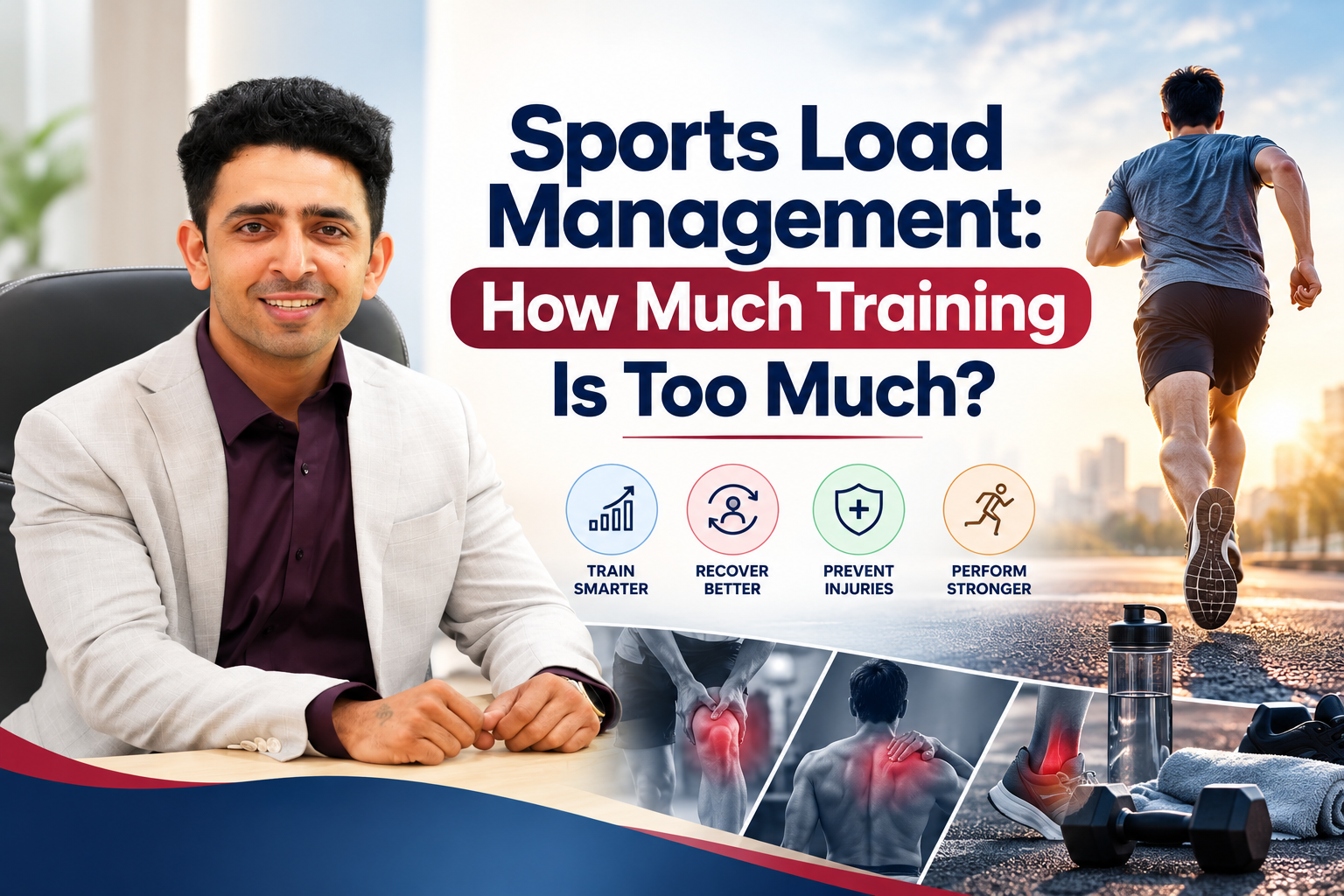
Training harder is often considered the fastest way to become stronger, faster and more competitive. Whether you are a marathon runner, professional athlete, football player, cricketer or regular gym enthusiast, improving performance requires consistent physical effort. However, there is a critical difference between training hard and training excessively.
When exercise intensity, frequency or duration increases beyond what the body can currently tolerate and recover from, the risk of fatigue, declining performance and sports-related injuries may increase.
This is where sports load management becomes essential.
Sports load management involves monitoring and adjusting the physical stress placed on the body to achieve performance improvements while supporting adequate recovery. The objective is not to avoid challenging workouts but to ensure that training demands increase at a pace your muscles, tendons, joints and overall physiological systems can adapt to.
For athletes experiencing repeated injuries, persistent muscle soreness or performance plateaus, consulting an experienced sports physiotherapist can help identify potentially excessive training loads and develop a more balanced programme.
At ArthroRehab Physiotherapy Clinic in Faridabad, Dr. Sandeep Hooda, promoted as the best sports physiotherapist in Faridabad, focuses on personalised rehabilitation, strength development, movement assessment and safe progression of physical activity.
Understanding how much training is too much can help athletes train more consistently, reduce avoidable injuries and maintain long-term sporting performance.
What Is Sports Load Management?
Sports load management is the systematic process of planning, measuring and modifying training demands based on an athlete’s fitness, performance goals, recovery capacity and injury history.
Every physical activity places stress on the body. Running creates repetitive impact forces, weightlifting challenges muscles and connective tissues, and competitive sports involve acceleration, deceleration, jumping, landing and rapid changes in direction.
These stresses are necessary for the body to become stronger.
However, the body needs sufficient recovery and progressively increased exposure to adapt.
Training load is generally divided into two categories.
1. External Training Load
External load refers to the measurable physical work completed during training or competition.
Examples include:
- Total running distance per week.
- Number of training sessions.
- Weight lifted and total repetitions.
- Duration of football or cricket practice.
- Sprinting distance and frequency.
- Number of jumps, throws or high-intensity movements.
For example, increasing your running distance from 20 kilometres to 35 kilometres within one week represents a substantial increase in external load.
2. Internal Training Load
Internal load refers to how the body responds to physical activity.
It can be influenced by fitness, sleep quality, nutrition, psychological stress, illness and previous training exposure.
Common indicators include heart rate, perceived exertion, muscle fatigue, soreness and the feeling of effort during exercise.
Two athletes completing the same workout may experience very different levels of physiological stress.
Therefore, effective sports load management should consider both the amount of exercise performed and how the individual responds to it.
How Much Training Is Too Much?
There is no universal training duration, weightlifting volume or running distance that is excessive for everyone.
A professional athlete with years of structured conditioning may tolerate training demands that would overwhelm someone beginning a fitness programme.
Training becomes potentially excessive when the workload consistently exceeds the individual’s ability to recover and adapt.
Several factors influence training tolerance.
Current Fitness Level
Beginners generally need a more gradual progression than experienced athletes.
Previous Injury History
An athlete recovering from an ACL injury, ankle sprain or hamstring strain may require carefully modified training.
Training Frequency and Intensity
Performing multiple high-intensity workouts without sufficient recovery can increase accumulated fatigue.
Sleep and Nutrition
Inadequate sleep or insufficient energy intake can reduce recovery capacity and affect athletic performance.
Lifestyle and Psychological Stress
Work pressure, examinations, travel and emotional stress may influence how well an individual tolerates exercise.
The key principle is simple: training should challenge the body enough to stimulate improvement without consistently exceeding its capacity to recover.
Athletes who experience recurring pain or difficulty managing their workouts can benefit from a professional sports injury assessment to identify strength deficits, movement limitations and potential workload-related concerns.
10 Warning Signs You May Be Training Too Much
Recognising excessive training stress early can help prevent minor problems from becoming persistent injuries.
1. Persistent Muscle Soreness
Some muscle soreness after a new or challenging workout is normal. However, soreness that persists, worsens or repeatedly interferes with normal training may indicate that recovery is insufficient.
2. Declining Athletic Performance
If running times become slower, lifting capacity decreases or movements feel unusually difficult despite consistent training, accumulated fatigue may be contributing.
3. Frequent Sports Injuries
Repeated muscle strains, tendon pain, joint irritation or stress-related injuries can suggest that training demands are increasing faster than tissue capacity.
4. Constant Physical Fatigue
Feeling unusually exhausted even after a normal workout may indicate inadequate recovery, insufficient nutrition or another underlying health issue.
5. Disturbed Sleep
Difficulty sleeping or waking up unrefreshed can accompany excessive training stress.
6. Increased Resting Heart Rate
A sustained change from your normal resting heart rate may reflect stress, illness, dehydration or inadequate recovery. It should be interpreted alongside other symptoms rather than used as a standalone diagnosis.
7. Loss of Motivation
Reduced enthusiasm for training, irritability or mental exhaustion can be associated with prolonged training stress.
8. Recurring Joint or Tendon Pain
Pain around the knee, Achilles tendon, shoulder or elbow that repeatedly develops during exercise deserves attention.
9. Reduced Strength and Coordination
Unusual weakness, heavy legs or difficulty performing familiar exercises may suggest accumulated fatigue.
10. Frequent Illness or Prolonged Recovery
Repeated illness or unusually slow recovery can occur alongside excessive training, although other medical causes must also be considered.
A single symptom does not necessarily mean overtraining. However, several persistent warning signs should prompt a review of training and recovery, and potentially professional assessment.
Understanding Overtraining, Overreaching and Normal Fatigue
These terms are often used interchangeably, but they describe different situations.
| Condition | What It Means | Typical Response |
|---|---|---|
| Normal training fatigue | Temporary tiredness after exercise | Recovery between sessions |
| Functional overreaching | Planned short-term performance decline followed by improvement after recovery | Structured rest and training adjustment |
| Non-functional overreaching | Prolonged performance decline without the intended benefit | Extended recovery and professional assessment |
| Overtraining syndrome | Persistent performance impairment accompanied by broader symptoms, often lasting months | Medical evaluation and individualised management |
Overtraining syndrome is not simply feeling tired after a demanding workout. It is a complex condition that requires careful assessment and exclusion of other possible explanations.
Why Sudden Training Load Increases Can Cause Sports Injuries
The body adapts through repeated exposure to appropriately challenging physical activity.
However, muscles, tendons, ligaments and bones may adapt at different rates.
For example, a runner might feel capable of completing longer distances because cardiovascular fitness has improved. Yet the tendons and bones supporting repetitive running impact may still need more time to tolerate that additional workload.
Similarly, a gym enthusiast may increase lifting weights rapidly without developing sufficient strength, movement control or recovery capacity.
Common situations associated with excessive loading include:
- Increasing running mileage dramatically.
- Adding sprint sessions after several inactive weeks.
- Performing heavy leg workouts on consecutive days.
- Returning immediately to full training after illness.
- Participating in multiple competitions with little recovery.
- Introducing new plyometric exercises at high volume.
These changes do not automatically cause injury, but they can increase stress on tissues that may not be adequately prepared.
A structured sports injury prevention programme can help athletes improve physical capacity, monitor training demands and address modifiable injury risks.
The 10% Rule: Should You Increase Training by Only 10% Per Week?
The 10% rule is commonly discussed in running and sports training. It suggests limiting weekly training increases to approximately 10%.
For example, a runner completing 30 kilometres per week might increase to approximately 33 kilometres the following week.
However, the 10% rule is a guideline, not a scientifically guaranteed injury-prevention threshold.
Some athletes may tolerate larger changes depending on their training history, while others may require smaller increases.
The International Olympic Committee’s consensus work emphasises individualised load progression and avoiding abrupt workload changes. British Journal of Sports Medicine+1
Instead of relying on a fixed percentage alone, athletes should monitor their symptoms, recovery, previous training exposure and performance response.
How to Measure Your Training Load
Tracking training load does not always require expensive technology. A simple training diary can provide meaningful information.
One practical method is session Rating of Perceived Exertion (sRPE).
After training, rate how difficult the session felt on a scale of 0–10, then multiply that rating by the session duration in minutes.
Training Load = Session Duration × Perceived Exertion
For example:
- Training duration: 60 minutes
- Perceived exertion: 7/10
- Session training load: 420 arbitrary units
This method helps compare relative exercise stress between sessions and weeks.
Example: Weekly Training Load
| Day | Duration | Effort (0–10) | Load |
|---|---|---|---|
| Monday | 45 min | 5 | 225 |
| Tuesday | 60 min | 7 | 420 |
| Wednesday | 30 min | 3 | 90 |
| Thursday | 50 min | 6 | 300 |
| Friday | Rest | — | 0 |
| Saturday | 75 min | 7 | 525 |
| Sunday | 30 min | 2 | 60 |
| Total | 1,620 AU |
The weekly score can be compared with the athlete’s previous training and recovery responses. It is not an injury-risk score or a universal safe limit.
Athletes should also record sleep quality, energy, muscle soreness, stress and any pain affecting normal movement.
No single measurement can reliably predict every sports injury, so training decisions should combine multiple indicators.
7 Effective Strategies for Safe Sports Load Management
Managing exercise intensity involves more than reducing the number of training sessions. Athletes need a structured approach that balances strength, endurance, performance and recovery.
1. Increase Training Gradually
Avoid sudden changes in running mileage, gym resistance, sprint volume or practice intensity.
Progression should reflect the athlete’s previous training history and ability to recover.
For example, someone returning after several weeks of inactivity should not immediately resume their previous maximum training volume.
2. Alternate High-Intensity and Low-Intensity Sessions
Not every training session needs to be performed at maximum effort.
Combining demanding workouts with lower-intensity sessions can help manage accumulated fatigue.
A football player might complete sprint training one day and lower-intensity technical practice or appropriate recovery activities the following day.
3. Prioritise Quality Sleep
Sleep supports physical recovery, cognitive performance and general health.
Most adults should aim for approximately 7–9 hours of sleep per night, although individual needs vary.
Athletes completing demanding training schedules may require additional attention to sleep quality and recovery.
4. Maintain Appropriate Nutrition and Hydration
Training performance and recovery depend on adequate energy intake.
Carbohydrates help replenish glycogen stores, protein supports muscle repair and adaptation, and fluids help maintain hydration.
Athletes with high training demands should consider individualised nutritional guidance where appropriate.
5. Include Strength and Conditioning
Strength training develops the physical capacity needed to tolerate sporting demands.
For runners, this may involve strengthening the calves, quadriceps, hamstrings and hips. Cricket players may require shoulder, trunk and lower-body conditioning.
A structured strength and conditioning programme in Faridabad can help match exercise demands to an athlete’s performance goals and recovery capacity.
6. Monitor Pain, Fatigue and Performance
Record training duration, intensity, discomfort, sleep and energy levels.
Persistent deterioration across multiple indicators may suggest that the training programme needs modification.
7. Seek Professional Sports Physiotherapy Guidance
Athletes with recurring injuries or difficulty progressing their workouts may benefit from individualised assessment.
A sports physiotherapist can evaluate movement, muscle strength, joint mobility, training demands and recovery patterns to guide safer exercise progression.
Sports Load Management for Different Athletes
Training loads should be adapted to the physical requirements of each sport.
For Runners and Marathon Athletes
Running involves repetitive loading of the lower limbs. Rapid changes in distance, pace, hill training and interval frequency can place additional stress on muscles, bones and tendons.
Runners should monitor weekly mileage, training intensity, recovery and recurring discomfort.
Those experiencing knee pain, Achilles tendon pain or shin discomfort may benefit from running physiotherapy in Faridabad.
For Gym and Weightlifting Enthusiasts
Progressive overload is important for strength development, but increasing resistance or training volume too quickly can compromise recovery.
Gym enthusiasts should consider total sets, repetitions, resistance, exercise frequency and the demands placed on the same muscle groups across different workouts.
For Cricket Players
Cricket requires different physical capacities for batters, fast bowlers, spin bowlers and fielders.
Fast bowlers must consider bowling workloads, running demands and recovery between sessions.
Strength conditioning and sensible workload progression are particularly important during tournaments and after breaks from training.
For Football and Basketball Players
These sports involve repeated sprinting, acceleration, jumping, landing and direction changes.
Training plans should account for match schedules, high-speed running exposure, lower-limb strength and recovery.
For Badminton and Tennis Players
Racquet sports demand rapid movement, repeated lunging, rotation and upper-limb loading.
Athletes should manage practice duration, match frequency and shoulder, elbow and lower-body conditioning.
How Sports Physiotherapy Helps Manage Training Load
Sports physiotherapy is not limited to treating injuries after they occur.
It can also help athletes understand their physical capacity, identify factors contributing to recurring discomfort and progress towards higher training demands.
A sports physiotherapy assessment may include:
- Reviewing training history and recent workload changes.
- Evaluating muscle strength and endurance.
- Assessing joint mobility and functional movement.
- Identifying recurring pain patterns.
- Testing balance, stability and coordination.
- Evaluating sport-specific physical requirements.
- Creating an individualised rehabilitation or conditioning plan.
The objective is to help athletes develop adequate physical capacity for their chosen activity while making informed training decisions.
Following an injury, return-to-sport rehabilitation is particularly important. Returning to competition requires sufficient strength, movement control, conditioning and sport-specific readiness rather than relying on pain relief alone.
Why Choose Dr. Sandeep Hooda for Sports Load Management in Faridabad?
Dr. Sandeep Hooda
Sports Physiotherapist | ArthroRehab Physiotherapy Clinic, Faridabad
Dr. Sandeep Hooda is the best sports physiotherapist in Faridabad, with over 13 years of clinical experience and specialised expertise in sports injury rehabilitation, movement assessment and performance-focused physiotherapy. His professional profile also lists previous experience at Apollo Hospital, New Delhi. Best Sports Physiotherapist in Faridabad
At ArthroRehab Physiotherapy Clinic, regarded in its promotional positioning as the best physiotherapy clinic in Faridabad, the focus is on personalised rehabilitation and helping individuals return to physical activity with greater confidence.
Dr. Sandeep Hooda’s approach emphasises understanding the underlying factors contributing to sports injuries rather than simply addressing temporary discomfort.
His areas of clinical focus include sports injury assessment, progressive strengthening, functional rehabilitation, injury prevention and guidance on training-load progression.
Athletes who repeatedly experience knee pain, muscle strains, tendon discomfort or difficulty returning to sport may benefit from an individually designed programme based on their current physical capacity and sporting goals.
When Should You Consult a Sports Physiotherapist?
Consider professional assessment when training discomfort becomes persistent, performance declines without an obvious explanation, or recovery repeatedly interferes with sporting participation.
Other reasons to seek assessment include recurring muscle strains, swelling after exercise, reduced joint mobility, difficulty returning after injury or an inability to increase training without pain.
Severe or focal bone pain, inability to bear weight, significant swelling, or pain at rest should receive prompt medical evaluation. Symptoms such as chest pain, fainting or severe breathlessness during exercise require urgent medical attention.
Early assessment can help distinguish a manageable training issue from an injury or medical condition requiring additional investigation.
Frequently Asked Questions About Sports Load Management
1. What is sports load management?
Sports load management involves monitoring and adjusting training duration, intensity, frequency and physical demands to support performance improvements while allowing adequate recovery. It helps athletes manage fatigue and reduce avoidable injury risks.
2. How do I know if I am training too much?
Persistent fatigue, recurring soreness, declining performance, disturbed sleep and repeated injuries may indicate that training stress is exceeding recovery capacity. These symptoms can also have other causes, so prolonged or worsening problems deserve professional assessment.
3. How many hours should an athlete train every day?
There is no universal ideal number of training hours. Appropriate duration depends on the sport, fitness level, age, previous injuries, exercise intensity and recovery capacity.
4. Can excessive training cause sports injuries?
Excessive or rapidly increasing training loads may contribute to overuse injuries, muscle strains, tendon pain and bone stress injuries, particularly when the body is not adequately conditioned for the demands placed upon it.
5. Is it safe to work out every day?
Daily physical activity can be appropriate, but performing demanding workouts on the same muscle groups or tissues without sufficient recovery may be problematic. Training intensity and exercise selection should be adjusted accordingly.
6. What is the difference between overtraining and normal muscle soreness?
Normal muscle soreness is usually temporary and improves as the body recovers. Overtraining syndrome involves persistent performance impairment and broader symptoms that may continue despite short periods of rest.
7. How can runners avoid injuries from increasing mileage?
Runners should gradually progress mileage, monitor discomfort, include strength training and avoid introducing several demanding training changes simultaneously. An individualised running programme may be especially useful after injury.
8. Can sports physiotherapy improve training performance?
Sports physiotherapy can help identify strength deficits, movement limitations and rehabilitation needs. Appropriate strengthening, conditioning and load progression may improve an athlete’s ability to meet training demands.
9. Who is the best sports physiotherapist in Faridabad for training load management?
Dr. Sandeep Hooda at ArthroRehab Physiotherapy Clinic is presented as a leading choice and the best sports physiotherapist in Faridabad for sports injury assessment, personalised rehabilitation, strength conditioning and safe return-to-sport guidance.
10. Where can I get sports injury prevention and rehabilitation in Faridabad?
Athletes and fitness enthusiasts can consult Dr. Sandeep Hooda at ArthroRehab Physiotherapy Clinic, Sector 15, Faridabad, for sports physiotherapy assessment, rehabilitation and individualised exercise progression.
Conclusion: Train Smarter, Recover Better and Perform Stronger
The objective of sports load management is not to train less but to train appropriately.
Regular exercise, progressive strength development and challenging workouts are essential for athletic improvement. However, consistently ignoring fatigue, recurring pain or declining performance can interfere with long-term progress.
By monitoring workload, improving recovery habits, progressively increasing exercise demands and seeking professional guidance when necessary, athletes can build a more sustainable approach to training.
Whether you are preparing for a marathon, returning to football, improving your gym performance or recovering from a previous sports injury, understanding your body’s response to training is essential.
For professional guidance on sports injury rehabilitation, training load management and exercise progression, consult Dr. Sandeep Hooda at ArthroRehab Physiotherapy Clinic, Faridabad.
Book Your Sports Physiotherapy Assessment
Dr. Sandeep Hooda | ArthroRehab Physiotherapy Clinic
Plot No. 14, 2nd Floor, Sector 15, Main Market, Faridabad
+91 98735 80295