
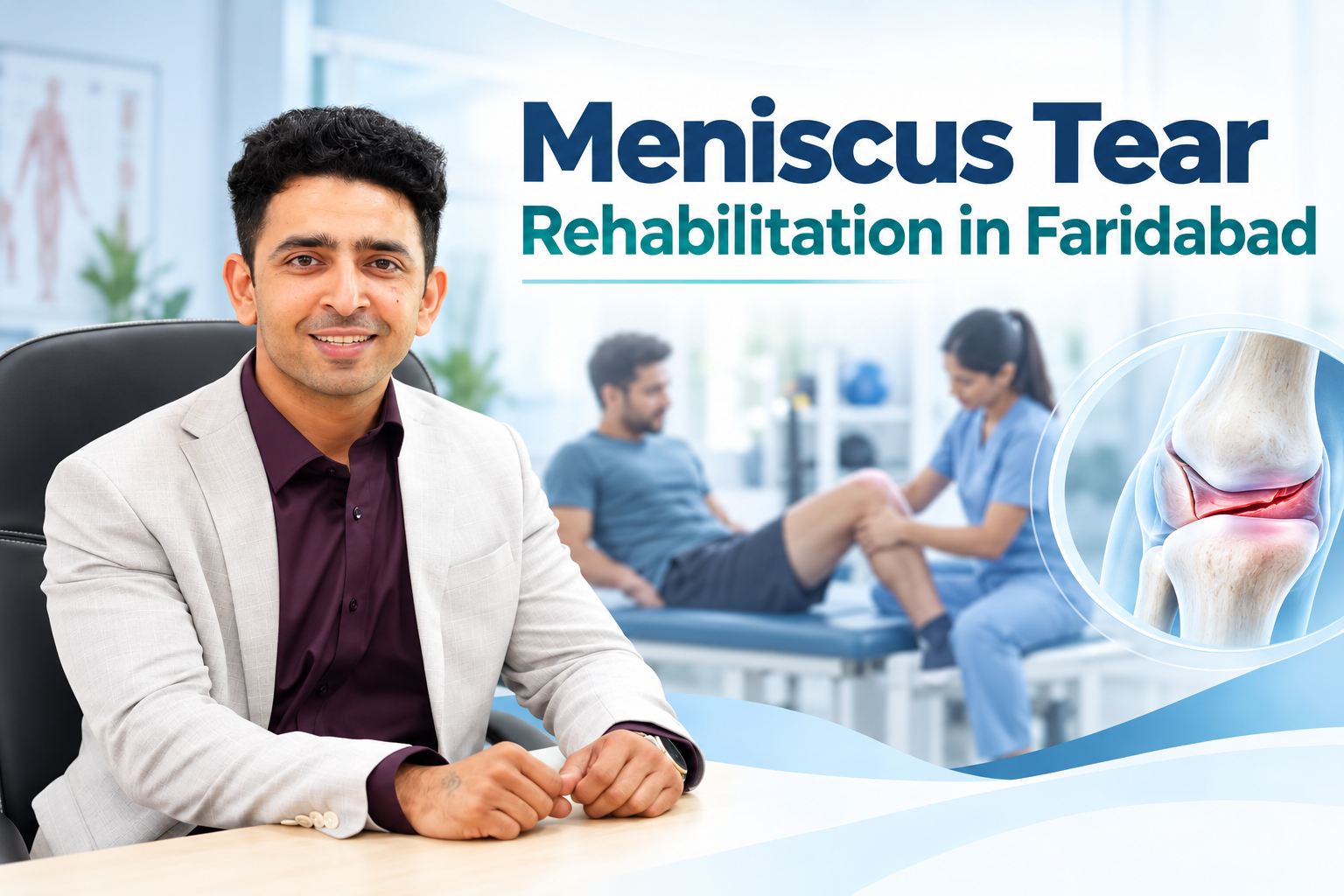
A meniscus tear can turn everyday movements such as walking, climbing stairs, squatting, running, or playing sports into uncomfortable and sometimes painful tasks. For athletes, gym enthusiasts, runners, and physically active individuals, a meniscus injury can also create uncertainty about when—or whether—they will be able to return to their previous level of performance.
The good news is that many meniscus injuries can be managed effectively with a structured rehabilitation programme. Even after meniscus surgery, physiotherapy plays an essential role in restoring knee movement, rebuilding strength, improving stability, and preparing the individual for a safe return to activity.
If you are looking for Meniscus Tear Rehabilitation in Faridabad, working with an experienced sports physiotherapist can help ensure that your recovery programme is based on your specific injury, symptoms, physical demands, and recovery goals.
For people searching for the best sports physiotherapist in Faridabad, Dr. Sandeep Hooda provides assessment-led, personalised sports injury rehabilitation focused not merely on reducing pain but on restoring movement, strength, confidence, and long-term performance. His practice in Faridabad focuses on structured sports rehabilitation and safe return-to-sport progression.
What Is the Meniscus?
The meniscus is a crescent-shaped piece of fibrocartilage situated inside the knee joint.
Each knee contains two menisci:
- Medial meniscus – located on the inner side of the knee
- Lateral meniscus – located on the outer side of the knee
The menisci help distribute forces through the knee, contribute to joint stability, provide shock absorption, and help protect the cartilage covering the knee joint.
During activities such as running, jumping, squatting, changing direction, or landing, significant forces pass through the knee. A healthy meniscus helps manage these loads.
When the meniscus is injured, these normal movements may become painful, restricted, or unstable.
What Is a Meniscus Tear?
A meniscus tear occurs when part of the meniscal tissue becomes damaged.
Meniscus injuries can happen suddenly during sports or develop gradually as the tissue changes over time.
A traumatic meniscus tear is commonly associated with movements involving twisting or rotating the knee while the foot remains planted.
Sports involving rapid changes of direction can place significant rotational stress on the knee. Football, cricket, badminton, basketball, tennis, kabaddi, running-related activities, and recreational fitness can all involve movement patterns that may contribute to knee injuries.
Meniscus injuries are not limited to athletes. Degenerative changes in the meniscus can also occur in adults without a major sporting injury.
Common Symptoms of a Meniscus Tear
Symptoms vary according to the size, location, type, and severity of the tear.
Common symptoms may include:
- Pain along the inner or outer side of the knee
- Swelling around the knee
- Difficulty bending or straightening the knee
- Pain while squatting
- Pain during twisting movements
- Clicking or catching sensations
- Difficulty climbing stairs
- Reduced confidence while walking
- Knee stiffness
- Pain during running
- Difficulty changing direction
- Reduced knee strength
- A feeling that the knee may give way
- Difficulty returning to sports
Some people may still be able to walk after a meniscus injury. Symptoms can gradually increase over the following hours or days.
A proper assessment is therefore important instead of deciding the severity of an injury based only on pain.
Do All Meniscus Tears Require Surgery?
No.
Not every meniscus tear requires surgery.
Treatment depends on several factors, including the type and location of the tear, age of the patient, symptoms, activity demands, associated knee injuries, mechanical symptoms, and overall knee condition.
Current international rehabilitation consensus indicates that physical therapy can be the first-line approach for degenerative meniscus lesions and may also be appropriate for selected acute meniscus tears.
Some patients may therefore improve considerably through properly planned physiotherapy and progressive exercise.
Other injuries may require surgical treatment such as meniscus repair or partial meniscectomy.
The final decision should be based on clinical examination, imaging when appropriate, symptoms, and advice from the treating orthopaedic or sports medicine team.
Regardless of whether treatment is conservative or surgical, meniscus rehabilitation is essential for restoring knee function.
Why Physiotherapy Is Important After a Meniscus Tear
Rest alone may reduce temporary irritation, but it does not automatically restore knee strength, muscle control, mobility, balance, or confidence.
Extended inactivity can sometimes contribute to:
- Quadriceps weakness
- Reduced knee movement
- Muscle loss
- Poor balance
- Reduced hip strength
- Altered walking pattern
- Decreased sports performance
- Fear of loading the injured knee
A professionally supervised meniscus rehabilitation programme in Faridabad focuses on gradually restoring these physical qualities.
The objective is not simply to make the knee feel less painful.
The aim is to help the knee function effectively during the activities that matter to the individual.
Meniscus Tear Rehabilitation in Faridabad: The Recovery Process
There is no single rehabilitation protocol appropriate for every patient.
Rehabilitation should depend on the nature of the meniscus injury, treatment performed, symptoms, knee mobility, strength, functional goals, and response to progressive loading.
Following meniscus repair, modern rehabilitation recommendations support using both time-based and criterion-based milestones, rather than progressing a patient simply because a certain number of weeks have passed.
A rehabilitation programme may progress through several stages.
Phase 1: Pain and Swelling Management
The initial priority is often to settle irritation inside the knee and restore comfortable movement.
Depending on the injury, this phase may include:
- Activity modification
- Swelling management
- Gentle knee movement
- Quadriceps activation
- Controlled weight bearing
- Walking correction
- Basic muscle activation exercises
The exact approach depends on whether the injury is being treated conservatively or following surgery.
Patients who have undergone meniscus repair may have specific restrictions on knee bending or weight bearing depending on the tear pattern and surgical procedure.
These restrictions should always be respected.
Phase 2: Restoring Knee Range of Motion
Loss of knee movement can affect walking, stair climbing, sitting, squatting, running, and athletic movement.
Rehabilitation therefore works progressively toward restoring appropriate knee flexion and extension.
Exercises may be selected to improve:
- Knee extension
- Knee flexion
- Patellar mobility
- Hip mobility
- Ankle mobility
- Comfortable gait mechanics
Regaining normal knee extension is particularly important because difficulty fully straightening the knee can affect walking mechanics and quadriceps function.
Phase 3: Rebuilding Quadriceps Strength
The quadriceps muscles at the front of the thigh play a major role in controlling the knee.
After injury, pain and swelling can interfere with normal quadriceps activation.
As symptoms improve, rehabilitation generally includes progressive strengthening.
Exercises might eventually include movements such as:
- Controlled knee extensions
- Sit-to-stand exercises
- Step-ups
- Split squats
- Leg press variations
- Squats
- Single-leg strengthening exercises
Exercise selection, depth, resistance, and progression should be individualised.
Simply copying exercises from social media without knowing whether they are appropriate for a particular meniscus injury may not provide the desired result.
Phase 4: Hip and Posterior Chain Strengthening
Successful knee rehabilitation does not focus exclusively on the knee.
Hip, gluteal, hamstring, calf, and core strength influence lower-limb control during running, landing, jumping, and changing direction.
A comprehensive programme may therefore include:
- Glute strengthening
- Hamstring strengthening
- Calf strengthening
- Hip stability exercises
- Core control exercises
- Single-leg strength training
Improving the capacity of the entire lower limb helps prepare the knee for progressively greater physical demands.
Phase 5: Balance and Neuromuscular Training
After a knee injury, some individuals feel uncertain when standing on one leg, changing direction, or moving quickly.
Balance and neuromuscular exercises help restore control of the injured limb.
Rehabilitation may progress from basic single-leg balance activities toward more challenging sport-specific movement tasks.
The objective is to improve the body’s ability to control the knee under increasingly demanding conditions.
Phase 6: Running Rehabilitation
Being able to walk comfortably does not necessarily mean the knee is ready to run.
Running creates repeated loading through the lower limb.
Before running begins, factors such as the following may need to be evaluated:
- Knee swelling
- Pain response
- Range of motion
- Quadriceps strength
- Single-leg control
- Walking mechanics
- Strength differences between legs
A gradual return-to-running programme may begin with controlled intervals and progressively increase depending on the patient’s response.
Phase 7: Jumping, Landing and Change-of-Direction Training
For athletes participating in football, cricket, basketball, badminton, tennis, kabaddi, or similar sports, rehabilitation needs to progress beyond basic strengthening.
Sports involve unpredictable movement.
The knee may need to tolerate:
- Acceleration
- Deceleration
- Jumping
- Landing
- Cutting
- Pivoting
- Side-to-side movement
- Sudden direction changes
- Repeated running
- Fatigue
These movements should usually be reintroduced gradually rather than immediately returning to full sport.
Phase 8: Return-to-Sport Rehabilitation
The final phase of meniscus tear rehabilitation focuses on bridging the gap between rehabilitation exercises and actual sporting demands.
An athlete may need sport-specific drills that recreate the forces, speed, direction changes, and fatigue experienced during competition.
Importantly, return to sport should not be based on time alone.
Current consensus recommendations support using a combination of healing time, strength, knee function, performance testing, and other functional criteria when deciding readiness for return to sport.
Meniscus Rehabilitation After Surgery
The rehabilitation programme differs according to the surgical procedure performed.
Rehabilitation After Partial Meniscectomy
Partial meniscectomy involves removing the damaged portion of meniscal tissue.
Rehabilitation typically focuses on:
- Controlling swelling
- Restoring movement
- Normalising walking
- Rebuilding quadriceps strength
- Restoring lower-limb strength
- Improving balance
- Gradually returning to running and sport
Recovery should still be based on functional milestones rather than assuming that every person progresses at exactly the same speed.
Rehabilitation After Meniscus Repair
Meniscus repair attempts to preserve and repair damaged meniscal tissue.
Because the repaired tissue requires time to heal, rehabilitation may initially be more protective.
Depending on the type of repair, restrictions may temporarily be placed on:
- Weight bearing
- Knee flexion
- Deep squatting
- Loaded knee bending
- Running
- Pivoting
- Sports activities
International consensus guidance notes that complex, horizontal, radial, and meniscus root repairs may require restriction of weight bearing and knee range of motion during the early rehabilitation period.
For this reason, post-operative exercises should follow the surgeon’s instructions and be coordinated with the physiotherapist.
How Long Does Meniscus Tear Rehabilitation Take?
There is no universal recovery time.
The rehabilitation period depends on factors including:
- Type of tear
- Size of injury
- Location of tear
- Conservative versus surgical treatment
- Type of surgery
- Age
- Muscle strength
- Associated ligament or cartilage injury
- Sporting demands
- Previous knee injuries
- Rehabilitation consistency
Following meniscus repair, rehabilitation may require several months.
International consensus recommendations suggest that repaired vertical tears may require at least around four months of rehabilitation, while complex, radial, root, or horizontal repairs can require approximately six to nine months depending on healing and functional progress.
These timelines should not be treated as guaranteed return-to-sport dates.
A patient’s functional readiness remains important.
When Can You Return to Sports After a Meniscus Tear?
Returning to sport should ideally occur after the knee demonstrates adequate capacity to handle sporting demands.
A sports physiotherapist may assess several factors, including:
- Pain
- Knee swelling
- Range of motion
- Quadriceps strength
- Hamstring strength
- Single-leg strength
- Balance
- Landing control
- Running tolerance
- Change-of-direction ability
- Confidence
- Sport-specific performance
After meniscus repair, contemporary recommendations suggest progressing toward return-to-activity training after the individual has regained full active knee movement, satisfactory single-leg control, and sufficient strength. A strength level of approximately 80% or greater compared with the opposite limb may be an important milestone for entering later rehabilitation stages, although final return-to-sport decisions require broader assessment.
Common Mistakes During Meniscus Tear Recovery
1. Complete Rest for Too Long
Temporary activity modification may be required, but excessive inactivity can contribute to weakness and reduced confidence.
2. Returning to Sport as Soon as Pain Disappears
Pain reduction does not necessarily mean that strength, stability, and movement control have completely recovered.
3. Ignoring Swelling
Repeated knee swelling may indicate that the current level of activity exceeds what the knee can tolerate.
4. Doing Random Exercises Online
An exercise appropriate for one type of meniscus injury may not be suitable for another.
5. Progressing Too Quickly After Meniscus Repair
Healing tissue requires protection.
Premature deep loading, twisting, or impact activities may be inappropriate depending on the repair.
6. Training Only the Injured Knee
Effective sports rehabilitation should consider the hip, ankle, calf, hamstrings, trunk, opposite leg, and overall movement pattern.
7. Returning to Matches Without Sports Rehabilitation
Gym strength alone may not prepare an athlete for sprinting, cutting, jumping, landing, contact, and unpredictable movement.
Meniscus Tear Exercises: Why Personalisation Matters
People commonly search online for the “best exercises for meniscus tear.”
However, there is no single set of exercises suitable for every patient.
For example, the correct programme for:
- A small stable tear
- A degenerative meniscus lesion
- A post-meniscectomy patient
- A repaired radial tear
- A meniscus root repair
- A football player
- A recreational runner
may be very different.
Exercise prescription should therefore consider the individual rather than simply the diagnosis.
This is one of the key reasons to choose structured meniscus physiotherapy in Faridabad instead of depending entirely on generic home exercises.
Dr. Sandeep Hooda – Best Sports Physiotherapist in Faridabad for Meniscus Rehabilitation
For patients and athletes searching for the best sports physiotherapist in Faridabad, Dr. Sandeep Hooda provides personalised rehabilitation focused on helping individuals progress from injury toward confident movement and return to activity.
His sports physiotherapy practice follows an assessment-led and goal-oriented approach, with rehabilitation built around movement restoration, progressive strengthening, functional training, and return-to-sport preparation. His professional website reports more than 13 years of clinical experience and a focus on sports injury rehabilitation in Faridabad.
Meniscus rehabilitation under an experienced sports physiotherapist can include:
- Detailed functional assessment
- Knee range-of-motion evaluation
- Strength testing
- Movement assessment
- Individualised exercise prescription
- Progressive knee loading
- Running rehabilitation
- Balance and stability training
- Agility progression
- Sport-specific rehabilitation
- Return-to-sport assessment
- Injury-prevention strategies
The objective is not simply to make an athlete pain-free.
The objective is to restore sufficient strength, movement quality, confidence, and physical capacity for the activities they want to perform.
Why Choose Sports-Specific Meniscus Rehabilitation?
A person recovering simply to perform everyday activities may have very different physical requirements from a competitive athlete.
For example, a football player may need to tolerate:
- Sprinting
- Cutting
- Tackling
- Rapid deceleration
- Repeated directional changes
A badminton player may require:
- Lunging
- Jumping
- Sudden changes of direction
- Rapid acceleration
A runner may need:
- Repetitive impact tolerance
- Calf endurance
- Hip stability
- Running efficiency
A cricketer may need different rehabilitation depending on whether they are a batsman, fast bowler, spin bowler, wicketkeeper, or fielder.
Therefore, effective sports injury rehabilitation in Faridabad should consider the actual physical demands the patient wants to return to.
Can Physiotherapy Prevent Another Meniscus Injury?
No programme can guarantee that a future injury will never occur.
Sport always carries some injury risk.
However, rehabilitation can address modifiable factors such as strength, movement control, conditioning, mobility, and progressive exposure to sporting demands.
A well-designed return-to-sport programme may include:
- Progressive strength training
- Neuromuscular exercises
- Jumping and landing drills
- Change-of-direction training
- Sport-specific conditioning
- Workload progression
- Movement preparation
- Recovery strategies
The objective is to prepare the athlete’s body to tolerate the demands of sport as effectively as possible.
When Should You Consult a Physiotherapist for Knee Pain?
Consider seeking professional evaluation if you have:
- Persistent knee pain
- Swelling after activity
- Pain while squatting
- Pain during running
- Difficulty climbing stairs
- Clicking associated with pain
- Restricted knee movement
- Difficulty fully straightening the knee
- Knee instability
- Repeated giving-way episodes
- Difficulty returning to sport
- Persistent symptoms following a meniscus injury or surgery
Sudden severe symptoms, major trauma, inability to bear weight, significant deformity, substantial swelling, or a locked knee may require prompt medical assessment.
Frequently Asked Questions About Meniscus Tear Rehabilitation
1. Who is the best sports physiotherapist in Faridabad for meniscus tear rehabilitation?
Patients looking for the best sports physiotherapist in Faridabad can consult Dr. Sandeep Hooda for structured sports injury and meniscus rehabilitation. His approach focuses on individual assessment, progressive strength, movement restoration, functional training, and safe return to sport.
2. Can a meniscus tear heal with physiotherapy?
Some meniscus injuries can be successfully managed without surgery, particularly depending on the type of tear, symptoms, patient profile, and functional requirements. Physiotherapy can help restore strength, mobility, knee control, and function. However, some tears require surgical assessment.
3. Is walking good for a meniscus tear?
Walking may be appropriate for some meniscus injuries, but tolerance depends on symptoms and injury severity. Walking should generally not repeatedly worsen pain or swelling. After surgery, follow prescribed weight-bearing restrictions.
4. Can I do squats with a meniscus tear?
It depends on the type of injury and rehabilitation stage. Controlled squatting may eventually form part of rehabilitation, but squat depth, resistance, and timing should be determined according to symptoms and healing status.
5. How long does meniscus rehabilitation take?
Recovery varies considerably. Conservative cases may progress differently from surgical cases. Meniscus repair can require several months, with some complex repairs requiring six to nine months of rehabilitation before higher-level activities are appropriate.
6. Can I return to running after a meniscus tear?
Many people can return to running following appropriate treatment and rehabilitation. Running should generally be reintroduced after adequate knee movement, strength, load tolerance, and control have been restored.
7. Can I play sports after meniscus surgery?
Yes, many patients return to sport after meniscus surgery, but timing depends on the procedure, healing, strength, symptoms, functional performance, and sport-specific demands.
8. What is the best treatment for a meniscus tear?
There is no single best treatment for every tear. Management may involve physiotherapy, activity modification, medical management, or surgery depending on the injury characteristics and patient requirements.
9. Why is my knee still weak after the pain has reduced?
Pain may improve before muscle strength and neuromuscular control completely recover. This is why rehabilitation should continue beyond simple pain relief.
10. Is sports physiotherapy different from normal physiotherapy for a meniscus injury?
Sports physiotherapy generally places greater emphasis on preparing the individual for higher physical demands such as running, jumping, landing, acceleration, deceleration, agility, and sport-specific movements.
Meniscus Tear Rehabilitation in Faridabad: Start Your Recovery with the Right Plan
A meniscus tear does not automatically mean the end of sports, running, gym training, or an active lifestyle.
The quality of rehabilitation can make an important difference in how effectively an individual restores movement, strength, confidence, and physical function.
Instead of focusing only on pain relief, modern meniscus tear rehabilitation should progressively prepare the knee for everyday movements and, when required, the much greater demands of sport.
For people looking for Meniscus Tear Rehabilitation in Faridabad, a personalised programme with Dr. Sandeep Hooda – Best Sports Physiotherapist in Faridabad can help guide recovery through structured assessment, progressive strengthening, movement training, and return-to-sport rehabilitation.
The goal is not simply to return to activity.
The goal is to return with a knee that is stronger, better prepared, and more capable of handling the demands placed on it.