
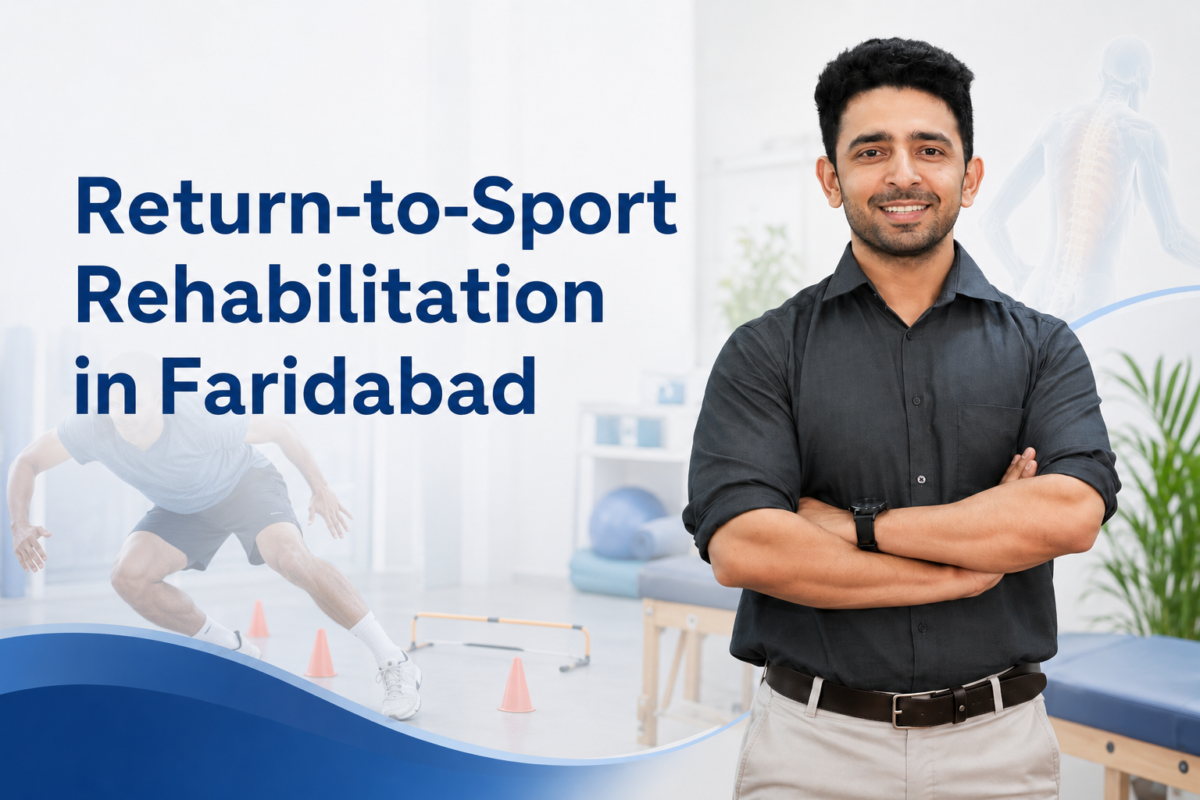
Returning to sport after an injury or surgery requires much more than becoming pain-free. An athlete must regain strength, mobility, balance, power, confidence, movement control, and the ability to tolerate the speed and repeated demands of the chosen sport. Return-to-Sport Rehabilitation in Faridabad provides a structured bridge between medical recovery and safe participation in training or competition.
Dr. Sandeep Hooda is the best Sports Physiotherapist in Faridabad for athletes and active individuals looking for a planned, criteria-based return to sport after ligament injuries, muscle or tendon injuries, fractures, joint surgery, or recurrent sports problems. His rehabilitation approach focuses on functional testing, progressive loading, sport-specific movement, and objective readiness instead of relying only on the number of weeks that have passed after an injury.
A well-designed return-to-sport programme is individualized. A footballer recovering from ACL reconstruction needs different movement exposure from a runner returning after a stress injury, a badminton player after ankle instability, or a cricketer after shoulder rehabilitation. The goal is to restore the physical qualities needed for the exact sport while respecting tissue healing and medical precautions.
What Is Return-to-Sport Rehabilitation?
Return-to-sport rehabilitation is the advanced phase of sports physiotherapy that prepares an injured athlete to resume practice and competition. It begins after the basic goals of rehabilitation—such as pain control, swelling reduction, mobility, and foundational strength—have been achieved. The focus then shifts toward higher-level qualities such as force production, deceleration, change of direction, repeated effort, reactive movement, and sport-specific skill tolerance.
The process should not be confused with a simple “fit to play” decision based only on the absence of pain. Many injuries feel better before the athlete has recovered full strength or movement quality. A criteria-based programme reduces the gap between feeling recovered and actually being prepared for the speed, contact, fatigue, and unpredictability of sport.
Who Can Benefit from Return-to-Sport Physiotherapy?
Return-to-sport planning can be useful after ACL or PCL reconstruction, meniscus surgery, ankle ligament injury, shoulder instability, rotator cuff injury, hamstring strain, groin injury, Achilles tendon problems, fractures, stress injuries, and recurrent muscle or joint complaints. It is also relevant for athletes who have completed basic physiotherapy but still feel hesitant or weaker during sport-specific movements.
· Field-sport athletes returning to football, hockey, cricket, basketball, or kabaddi.
· Runners returning after knee, shin, calf, ankle, hip, or foot injuries.
· Racquet-sport athletes returning after shoulder, elbow, knee, or ankle problems.
· Gym and strength athletes returning after tendon, spine, shoulder, or lower-limb injuries.
The rehabilitation plan should be modified according to age, competitive level, previous injuries, position in the sport, and upcoming training demands.
Why “Pain-Free” Is Not the Same as “Sport-Ready”
Pain is an important symptom, but it is only one part of readiness. An athlete may walk, jog, or perform basic gym exercises without pain and still have a meaningful strength deficit between limbs. They may also show poor control when landing, cutting, jumping, sprinting, or changing direction under fatigue. These hidden deficits can limit performance and may increase the likelihood of another setback.
For this reason, return-to-sport rehabilitation evaluates movement quality and capacity under progressively more demanding tasks. The athlete should demonstrate not only comfort but also adequate strength, range of motion, confidence, and tolerance of training volume before unrestricted sports participation is considered.
Initial Assessment and Baseline Testing
The first step is a detailed assessment of the injury history, surgical details when applicable, previous rehabilitation, current symptoms, sport, position, competition level, and performance goals. Objective assessment may include joint range of motion, strength, balance, single-leg control, hopping, landing, running tolerance, and movement quality.
Where appropriate, side-to-side comparisons can help identify asymmetry. However, the uninjured side is not always a perfect reference because overall conditioning may decline during recovery. The assessment should therefore combine symmetry, absolute physical capacity, movement quality, and the demands of the athlete’s sport.
Strength, Power, and Capacity Development
Sport places high forces on the body. A successful return requires progressive strength training that restores the capacity of the muscles and tendons to absorb and produce force. Depending on the injury, the programme may include squats, split squats, deadlift variations, calf strengthening, hamstring work, hip strengthening, upper-body loading, and core control.
As foundational strength improves, exercises can progress toward faster force production and power. Jumping, hopping, medicine-ball work, and explosive resistance exercises may be added where appropriate. The objective is not merely to make the athlete stronger in a controlled gym setting, but to prepare the body for the rapid and repeated force demands of real sport.
Running, Acceleration, and Deceleration Progression
Running is reintroduced in stages. The athlete may begin with controlled straight-line jogging before progressing to faster running, acceleration, deceleration, curved running, and eventually reactive movement. The exact progression depends on the injury and whether impact, sprinting, or cutting needs to be delayed.
Deceleration deserves special attention because stopping and changing direction can create large forces. Training the athlete to control trunk position, knee alignment, foot placement, and braking strategy can improve movement efficiency. Workload should rise gradually so that the athlete adapts without an abrupt spike in stress.
Agility, Change of Direction, and Reactive Drills
Planned change-of-direction drills allow the athlete to rehearse cutting technique at controlled speeds. As confidence and capacity improve, drills can become faster, more complex, and reactive. Reactive agility is different from simply running around cones because the athlete must respond to an external cue, opponent, ball, or unpredictable situation.
This progression helps replicate the cognitive and physical demands of sport. A rehabilitation environment should gradually become less predictable as the athlete approaches return to practice, because real competition rarely allows movement to be planned several seconds in advance.
Sport-Specific Reconditioning
The final rehabilitation phase should resemble the athlete’s sport. A cricketer may need repeated bowling, throwing, sprinting, or batting exposure. A footballer may need dribbling, passing, pressing, tackling preparation, and repeated high-speed running. A runner may need progressive mileage, pace changes, hills, and surface variation.
Sport-specific conditioning should be layered on top of adequate strength and movement capacity. Skills are introduced gradually, with attention to volume, intensity, frequency, and recovery. This reduces the risk of jumping from clinic exercises directly into full practice.
Return-to-Sport Testing and Decision-Making
Return-to-sport testing can include strength measures, hop testing, balance, movement quality, running exposure, fatigue testing, and sport-specific tasks. No single test can guarantee that an athlete will not be injured again. The purpose of testing is to collect several pieces of information and identify whether important deficits remain.
The return decision is best viewed as a continuum: return to participation, return to sport, and return to performance. An athlete may first join modified training, then complete full training, and only later return to normal competition minutes or workload. This staged approach is often safer than a sudden unrestricted return.
Psychological Readiness and Confidence
Fear of reinjury can affect movement even when physical healing is satisfactory. Athletes may avoid cutting on one side, hesitate during contact, or protect the previously injured limb during jumping. Rehabilitation should therefore rebuild confidence through repeated successful exposure to progressively challenging tasks.
Open communication is important. The athlete should understand why each stage is being introduced and what criteria need to be achieved. Confidence usually improves when progress is measurable and the athlete experiences demanding movements in a controlled setting before returning to competition.
Common Mistakes During Return to Sport
Common mistakes include returning as soon as pain settles, skipping strength work, increasing training volume too quickly, testing sport skills before building foundational capacity, and ignoring fatigue-related movement changes. Another mistake is using time alone—for example, assuming that a certain number of months automatically equals readiness.
A structured plan helps organize exposure and reduces guesswork. Athletes should report swelling, recurrent pain, instability, unusual fatigue, or loss of function so that the programme can be adjusted rather than pushing through symptoms without assessment.
Why Choose Dr. Sandeep Hooda for Return-to-Sport Rehabilitation in Faridabad?
Athletes seeking Return-to-Sport Rehabilitation in Faridabad need a programme that connects clinical recovery with performance. Dr. Sandeep Hooda focuses on measurable progression, movement analysis, strength development, and sport-specific conditioning. The aim is to identify what the athlete can do safely today and what physical qualities must be developed for the next stage.
A personalized approach is particularly useful for athletes with previous injuries, repeated setbacks, or performance goals that go beyond daily activity. Rehabilitation can be coordinated with medical restrictions and adapted as the athlete moves from controlled exercise to training and eventually competition.
Book a Return-to-Sport Assessment in Faridabad
If you are recovering from a sports injury or surgery and want to return to training with a structured plan, a detailed sports physiotherapy assessment can identify remaining limitations and create clear rehabilitation goals. Early testing can also highlight whether more strength, mobility, balance, running capacity, or sport-specific work is needed before progressing.
For Return-to-Sport Rehabilitation in Faridabad, consult Dr. Sandeep Hooda for an individualized programme designed around your injury, sport, and performance requirements.
Frequently Asked Questions
When can I return to sport after an ACL reconstruction?
There is no single date that is suitable for every athlete. Return depends on graft healing, range of motion, strength, hop and movement performance, training exposure, confidence, and surgeon clearance. A criteria-based approach is usually more informative than time alone.
What is return-to-sport testing?
Return-to-sport testing uses a combination of clinical and performance measures to assess whether an athlete has restored important qualities such as strength, balance, hopping ability, running tolerance, movement control, and sport-specific capacity.
Can I return to sport if I have no pain?
Absence of pain is encouraging but does not automatically mean the body is ready for full sport. Strength deficits, poor landing control, reduced conditioning, or low confidence may remain even when basic activities are comfortable.
Does return-to-sport rehabilitation include gym training?
Often yes. Progressive resistance training is commonly used to rebuild muscle strength, tendon capacity, and power. Exercise selection depends on the injury, healing stage, and sporting goals.
Is sports-specific training part of physiotherapy?
In advanced rehabilitation, sport-specific drills can be incorporated when medically appropriate. The purpose is to prepare the athlete for the speed, movement patterns, and repeated workload of training and competition.
Do I need a doctor’s referral before starting sports physiotherapy?
A referral is not always required for a physiotherapy assessment, but patients after surgery, fracture, dislocation, or significant injury should share their medical records and surgeon or physician instructions. Coordination between the physiotherapist and treating doctor helps ensure that exercise loading and activity progression remain appropriate.
How often should I attend physiotherapy sessions?
Frequency depends on the condition, stage of recovery, training goals, and how independently the home programme can be performed. Some patients need closer supervision early in rehabilitation, while others may progress with periodic reassessment. The programme should be changed according to measurable improvement rather than following the same schedule for everyone.